Showing posts with label Backchannel. Show all posts

Sunday, 17 April 2016

Gamification at #BbTLC16

Earlier this month I was at #BbTLC16 - the annual Blackboard Teaching & Learning conference, which took place in Groningen this year. I've been meaning to write a couple of blog posts about it, and what I learned there, but have been so busy since I got back! That's the downside of being at a conference, work just piles up and waits for you to return.


One of the interesting features of the conference this year was the use of the mobile app, which we were encouraged to download prior to the event.

As well as easy access to the programme, and the ability to build up a personal agenda, there were a couple of other features that added to conference experience (positive and negative) and ultimately had an affect on my behaviour as part of the backchannel, as well as others.

Mobile Agenda

There was (initially) no printed programme available at the conference. The online programme was a little tricky to navigate, with up to 6 parallel sessions each day, and I certainly didn't pay it much attention before travelling. So it was extremely useful to be able to browse the programme using the app. Each session had a very short description, or you could browse by speaker, and add talks of interest to a personal agenda. If you allowed notifications, you would even get a reminder when a particular talk was about to start. With my increasing reliance on online calendars, this proved to be a very useful feature.

This is where the gamification starts. Once in a particular session, you then had an option to "check-in", allowing you to collect points. When a session finished, you were presented with an option to rate (out of 5) and make comments on the talk. Each of these activities allowed you to collect further points. It's not entirely clear where the ratings and comments went - but presumably the conference organisers are using them in some way. As a speaker, I certainly have not seen any feedback on our presentation.

Community

On first accessing the app, I was encouraged to create a profile, linking it to my LinkedIn, twitter and/or Facebook accounts. I used the opportunity to link to LinkedIn and twitter, but my Facebook activity is much more personal.

Within the app, it was possible to browse all Attendees (and separately all Speakers), including Blackboard personel and other sponsors, thus finding out a little more about them, and also see what networks they had shared. This was very useful for following up on new acquaintances, leading to some new LinkedIn connections and Twitter followers.

Activity

Now things start getting interesting! One of the main features, once the conference started, was the activity feed. Like a conference twitter feed, users of the app could post updates, with links, pictures and videos. We could also "like" posts and even comment on them. Before long, we realised that we could earn badges by posting, commenting, rating, checking-in. I managed to get 22 out of 27 possible badges!

Posting to the activity feed became an obsession. While it should have been possible to send everything to Twitter as well, this didn't really happen. I had no success posting to Twitter at all, while photos were missing from other people's tweets. This meant that the (public) activity using the #BbTLC16 hashtag was not particularly active. For my part, I did try to tweet some of the announcements that were made, but it was awkward to keep the activity going in two places, as well as trying to take notes. The very active backchannel that was happening around the conference was enclosed within the app, behind closed doors.

As with most conference backchannels, it was very useful to find out what was going on in another parallel session. Images, updates and comments, especially those from particular individuals, could really give a sense of what was being discussed, and it was possible to join in a conversation from another room, or to follow up with particular speakers or attendees during the networking breaks.

The LeaderBoard
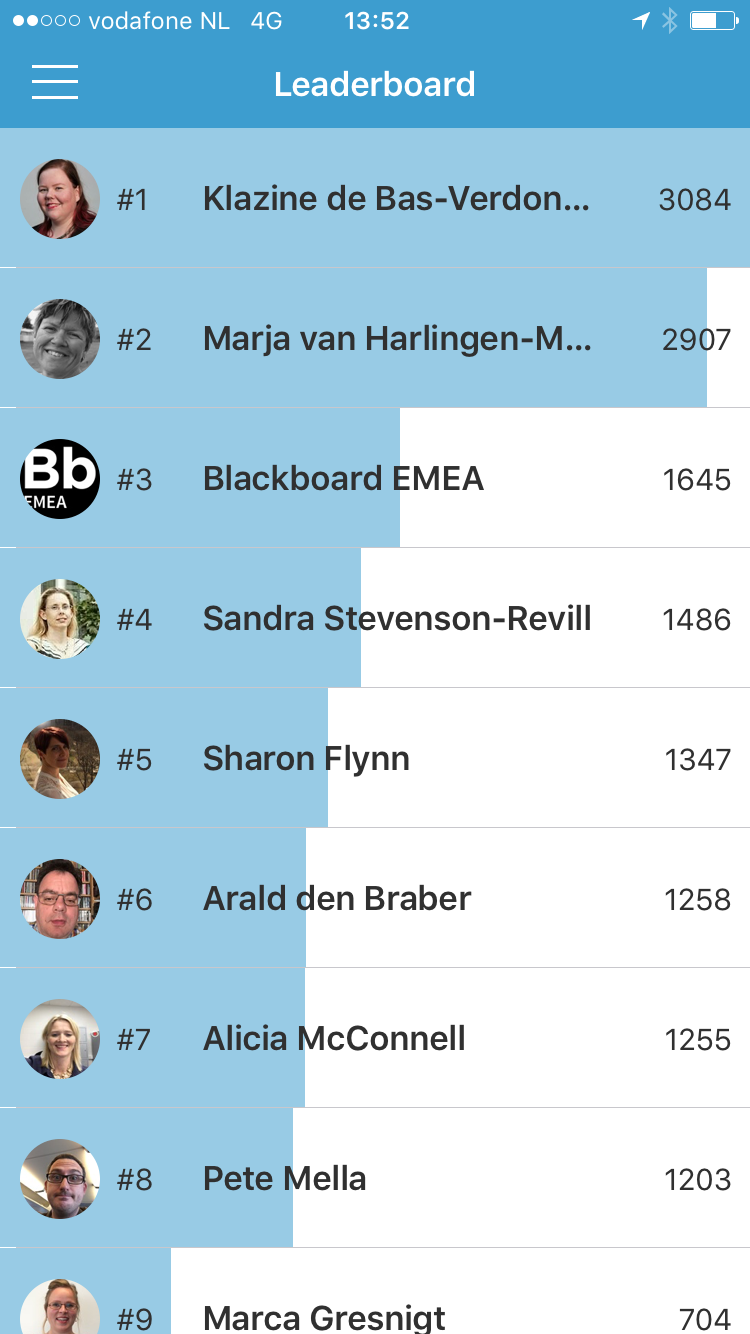
While we were all very busy earning badges, posting pictures of the same powerpoint slide from different angles and distances, we were also earning points. Every activity had an associated point value, though exactly how these were calculated is not clear. Moreover, it was possible to check out the LeaderBoard from within the app. Initially, some of the attendees of DevCon (a pre-conference for developers) were at the top of the board, but before long some of the more competitive types (myself included) started making our way up the board.

It was all a bit of fun. Wasn't it? Until we realised that the activity of "Liking" posts clearly resulted in more points - even Liking your own posts! Something was clearly amiss here. You could barely post anything before it received half a dozen "likes".

At this stage I will state very clearly - I did not start Liking my own updates. Competitition was fierce, though, and it soon became clear that it would not be possible to catch up with the frontrunners.

In the end, I finished a respectable 5th, and I'd like to give a shout out for the two leaders Klazine and Marja who played a very strong game - they left us behind for dust. Kudos also to Pete, Alicia and Sandra - the latter sneaked ahead of me on the last day. What does it say that 13 of the top 20 positions were taken by women?

Final Comments

Certainly the app was useful and fun, and the gamification brought a new community experience to the conference - though possibly not what was intended. It was a shame that the backchannel was closed, but I think this could be easily remedied by improving the ability to publish to twitter at the same time.

The gamification was interesting. How points were allocated is not clear, but it seems that the allocation needs to be rebalanced a little bit, to encourage more activity with added value.

Monday, 22 June 2015

#celt15: Getting Real about Virtual Learning

Last Friday (19th June) was our CELT Symposium on the topic Getting Real about Virtual Learning. It was a fantastic day (despite the weather) with about 200 participants and plenty of learning.

Twitter at #celt15

Thanks to the twitter team (@gramcgrath, @marloft, @allaboardHE, @catherinecronin, @rosenidhubhda, @TELtales) and all the lovely tweeps at the conference, there were almost 1200 #celt15 tweets on Friday alone, and we trended in Ireland for most of the day!

The quality of the backchannel was quite amazing. I've created a semi-structured archive of all the comments and pictures using storify, which gives a sense of the day.

A beautiful TAGSExplorer visualisation of all the tweets for the hashtag was created by Martin Hawsey's Twitter Archiving Google Sheet (TAGS). From here you can find the top tweeter from the conference (@iainmacl) and the top conversationalists (@worried_teacher and @sharonlflynn). TAGS also produces a searchable archive of the conference tweets.

Keynotes at #celt15

Both Sian Bayne and Doug Belshaw gave very exciting and thought-provoking talks at #celt15. These have been recorded and we should be able to make them available soon.

In the meantime, Doug has already made his presentation available on Slideshare:


Identifying, scaffolding, and credentialing skills in an ever-changing digital environment from Doug Belshaw

And Sian Bayne's paper Teacherbot: Interventions in Automated Teaching is also available online.

Presentations from the event

At least one presenter has shared his presentation using Slideshare. If anybody else has shared their presentation, please let me know and I'll add it here:


Wednesday, 17 June 2015

#celt15 Instructions to the twitter team

This is based on the original post by @derekbruff who has kindly given his permission to re-blog. It's an updated version of the #celt13 instructions, posted on this blog 2 years ago.

Hello #celt15 twitter team (you know who you are) and thank you for agreeing to take part. We're looking forward to an active twitter stream at #celt15 again this year and you will play a big part in keeping the backchannel going. What does it mean to be on the #celt15 twitter team? Glad you asked....


  1. Take a few moments at several points during the day (during keynotes, during sessions, whenever) to share highlights of the conference.  What are you learning?  What useful resources are you hearing about?  (Include links when you can!)  What questions or answers are occurring to you as you  participate in the conference?
  2. Don't forget to use the hashtag! It's #celt15.
  3. You’re encouraged to tweet some photos of the conference. Having some photos in the Twitter steam makes the conference experience more concrete for folks not there.
  4. Feel free to be critical when appropriate, but please always be civil.  If one of the keynotes, for instance, turns out to be a big dud (unlikely - given that we've got Sian Bayne and Doug Belshaw), let’s not have any harshtagging or tweckling.  (See http://chronicle.com/article/Conference-Humiliation-/49185/.)
  5. Engage with other #celt15 Twitter participants, including those not physically present: respond to questions and add value when you can.
  6. Finally, if a conference participant new to Twitter starts asking you about Twitter, be ready to share your experiences. The conference is all about new skills, so demonstrate how Twitter can be a part of it.
I am already collecting an archive of all the tweets related to the hashtag, using Martin Hawksey's excellent Twitter Archiving Google Sheet (TAGS). As of this morning, two days before the conference starts, there are already more than 300 tweets in the archive. Who will be top tweeter this year? And who will be top conversationalist? Watch this space to find out.
 
#celt15 is the official hashtag of the 13th Galway Symposium, entitled Getting Real About Virtual Learning.


Monday, 24 June 2013

Social Media at #celt13

Earlier this month we had our annual Galway Symposium on Higher Education, entitled "Thinking Differently" - New Curricula, New Skills in Higher Education.

Although the conference theme itself is not technology-focused, we did make use of technology to support and enhance the conference experience.

Twitter

Back in March, we agreed the twitter hashtag for the conference and I used Martin Hawksey's excellent Twitter Archiving Google Spreadsheet to start archiving all tweets using the hashtag.

About 2 weeks before the conference itself, I enlisted the help of a twitter team, targeting people that I knew would be at the conference and giving them advice on how to keep the backchannel going. This meant that we had an active twitter stream before, during and after the conference, with about 850 tweets currently in the archive.

The Archive Tool produces a complete archive and TagsExplorer, which lets you explore the connections between the people who are tweeting. 

From this we can see that Helen Crump (@crumphelen) wins the award for Top Conversationalist.

The award for Top Tweeter, however, goes to Iain Mac Labhrainn (@iainmacl)


Streaming and Recording of Keynotes 

During the conference, we had some excellent speakers, including: Prof. Marijk van der Wende, Amsterdam University College; Dr. Camille Kandiko, King's College London; Dr. Vicky Gunn, University of Glasgow; Dr. Alastair Robertson, Abertay University; and Prof. Derek Raine, University of Leicester. Their presentations were all streamed, the link being broadcast regularly on Twitter. Recordings of the keynotes are all available, via the Kaltura platform, on the conference website.

Conference Photos

Finally, I'd like to mention the excellent work done by Blaneth and Margaret on taking images from the conference and putting them into this very nice little animation using animoto:


All of these technologies facilitate us to archive the conference in different ways, allowing the conversations to continue. Hopefully this blogpost will further support the discussion.


Sunday, 10 June 2012

Top Tweeters at #celt12

Using Martin Hawksey's twitter archiving google spreadsheet, we can now reveal the top tweeters at the 10th Galway Symposium: The Written Word - writing, publishing and communication in higher education.

The conversation is still continuing, using the #celt12 hashtag . So far, we have archived more than 1000 tweets from the event.


To see a visual representation of the archive, you can visit the Interactive Archive of #celt12 tweets (static image below). Click on any name to get a list of that person's tweets and interactions.


A full archive of tweets, though it's not particularly pretty, is also available.


Tuesday, 5 June 2012

#celt12 Instructions to the Twitter Team

This is based on the original post by @derekbruff who has kindly given his permission to re-blog for #celt12.

Hello #celt12 twitter team (you know who you are) and thank you for agreeing to take part. We're looking forward to an active twitter stream at #celt12 this year and you will play a big part in keeping the backchannel going. What does it mean to be on the #celt12 twitter team? Glad you asked....

  1. Take a few moments at several points in each day (during keynotes, during sessions, whenever) to share highlights of the conference.  What are you learning?  What useful resources are you hearing about?  (Include links when you can!)  What questions or answers are occurring to you as you  participate in the conference?
  2. Don't forget to use the hashtag! It's #celt12.
  3. You’re encouraged to tweet some photos of the conference if you have that ability. Having some photos in the Twitter steam makes the conference experience more concrete for folks not there.
  4. Feel free to be critical when appropriate, but please always be civil.  If one of the keynotes, for instance, turns out to be a big dud, let’s not have any harshtagging or tweckling.  (See http://chronicle.com/article/Conference-Humiliation-/49185/.)
  5. Engage with other #celt12 Twitter participants: respond to question and add value when you can.
  6. Finally, if a conference participant new to Twitter starts asking you about Twitter, be ready to share your experiences. The conference is all about written communication in Higher Education, so demonstrate how Twitter can be a part of it.
#celt12 is the official hashtag of the 10th Galway Symposium, entitled The Written Word: Writing, Publishing and Communication in Higher Education.