Showing posts with label Conferences. Show all posts

Friday, 16 March 2018

CESI Conference 2018 - Shaping Tomorrow Today

As I have for many years now, I attended the annual CESI conference and TeachMeet this past weekend. This year differed in that the conference was postponed by a week thanks to Storm Emma. Despite the setback, things ran like clockwork, mostly thanks to a lot of behind the scenes work. On that note, I should also point out that I am a member of the CESI National Executive and part of the conference organising committee. Hence, I was keenly aware of the behind the scenes work going on!

The now traditional TeachMeet went ahead on the Friday evening before the conference. I was presenting on our new Digital Champions Engagement Toolkit that was published the following week as part of the All Aboard! Project. Though the resource was written for higher education, there seemed to be a keen interest from attendees to adapt it to their own needs in their own sectors.

The TeachMeet runs at a rapid pace, so it's usually best to Tweet or take notes to follow up on later.  Presentations were ride ranging - from social justice, to computer science, and to slowing down. Follow the hashtag for more.

The conference theme was anchored heavily on the past and present, and CESI's role in shaping the use of technology in Irish education. The keynotes involved Richard Millwood as the leader of the CESI.CS Community of Practice, and Elizabeth Oldham as the CESI historian. The underlying debate came back to computers, in education or otherwise, being firmly about the people that use them.

 As things go with conference organising, I only really got to presentations that I chaired, which was useful as I'd chosen to chair them for a reason. Next up for me, was Bea de los Arcos talking about open textbooks.

Bea drew a crowd, and engaged the audience.  The debate around open textbooks seemed to centre around quality, and that assumption was quickly quashed as we looked at the success and quality of other OERs.

Joanna Norton looked at 21st century learning and some of the obstacles we face, like the exams system, privilege, and social justice.

Orna Farrell from DCU shared an OER that she created called The History Lab for her distance learning students, and also the wider education community.


From a higher education perspective, it was particularly interesting to see an open resource being showcased as a success, when so much of online learning in the sector takes place on pricey, private platforms. It seemed to be a nod back to Domain of One's Own, and as a bountiful resource, it should indeed be shared widely.

Stephen Howell finished the day with a capstone looking toward the future, and the human applications for the tools we're using.
As always, the CESI conference proved to be absolutely exhausting, and absolutely exhilarating.  The CESI community is strong, and with the advent of Leaving Certificate Computer Science this year, only gaining momentum. 

Monday, 19 June 2017

ILTA EdTech 2017 Conference - TEL in an Age of Supercomplexity Challenges, Opportunities and Strategies


As our own CELT Symposium looms at the end of the week, it seems fitting that I finally reflect on the last conference I attended.  

This year's EdTech theme allowed us to pause and reflect about TEL in a complex age. Throughout the two day event, it was evident that we are indeed facing challenges, but also using those challenges to create strategies and opportunities.  

The first keynote of day one was from Gráinne Conole, who is currently a visiting professor at DCU. She focused on the future of learning and harnessing technologies.  Her presentation encompassed so much of the landscape and set the scene well for what was to come.  In discussing the characteristics of the 21st century learner, necessary digital literacies, the integration of OERs, structures of MOOCS, and the benefits for students; she arrived at a heutagogical approach that allows students more affordances in the Web 2.0 landscape. 
In summation, she called on us to rigorously approach learning design, to harness the power of analytics, and implement pedagogies that support the supercomplexity of the future.  Her slides can be found here:

The next session that I attended, Assessment and Feedback in the Digital Age, was rife with ideas, but one in particular stood out to me.  Mark Glynn from DCU posed a simple idea:

I really appreciated how such a nuanced idea could sum up the whole TEL landscape so succinctly.  It's clear that even in our terminology we can accidentally place the focus on the technology rather than the pedagogy.

The Global Challenges in Higher Education session was led by Lawrie Phipps and Donna Lanclos. The discussed Leading with Digital in an Age of Supercomplexity, and namely on the JISC Digital Leaders programme. As a bit of a fan, I get presumptuously excited that Donna was in Sligo, but I was to be disappointed.
At the same time, I unfortunately missed Mary Loftus speaking about her work on learning analytics, but her slides are available here:

The second keynote from Professor Paul J. LeBlanc, President of Southern New Hampshire University.  He discussed the success of competency based learning at SNHU. He also joked that Americans don't talk about MOOCs as much as the Irish do at an ed tech conference!
The Jennifer Burke award went to Antonio Calderón of UL for a fantastic project with initial teacher educators in PE.  This project, #CoolPE, is definitely worth looking at, as it could be adapted across sectors and subject areas.
On a beautiful Friday morning, we launched into day two of the conference.

Mark Glynn outlined Turning off Turnitin.  This might sound like a frightening challenge, but Mark was open and candid about the process, and the difficulties they faced.
Niall Watts from UCD, again quite candidly, discussed the creation and use of MOOCs in first year Geography to largely positive feedback from students. His slides can be accessed here.
I unfortunately missed our NUI Galway colleague, Bonnie Long, talk about the Flipping the Flipped Classroom:
One stand out presentation for me was from Sam Cogan of the National College of Ireland, who discussed dual delivery in his lectures.  I've flagged this one for follow up, as he seems to be actively and progressively focused on changing the dynamics of the lecture hall.
Professor Meg Benke's keynote was refreshing in its reflective nature and its focus on scholarship through the work of Boyer.  She discussed the importance of education, communities of practice, and new methodologies in the age of supercomplexity.

It was also announced that ILTA would co-sponsor ten people going forward for CMALT certification.
In closing, ILTA made a call for members to get involved in the coming year.  It should also be noted that submissions are welcome for the Irish Journal of Technology Enhanced Learning.
Reflecting on the two days, it's evident that in age where we as practitioners are faced with complex challenges, that we must remain vigilant and become involved, reflective, and active practitioners. The keynote speakers and presenters at this year's conference are working through challenges and planning for an uncertain future, while focusing on learning and success that is only enhanced through technology.

And on a final note, videos will be available soon!


Wednesday, 22 June 2016

Etiquette for tweeting at conferences - an honest question

I've been using twitter for more than seven years, as many of my readers will already know. One of the most useful aspects of twitter, for me, involves tweeting at conferences - whether I am at the conference, or following a conference hashtag. As well as being part of the general conference discussion and backchannel, it also offers insight to an event beyond the traditional boundaries of location.

How I use twitter at conferences


If I am (physically) attending a conference, my usual style is to tweet key ideas, references, links, and photos of the speaker and his/her slides. More recently, since I'm trying to make written notes (yes - on paper) I will also tweet an image of my notes. I converse with other twitter users, who may be co-located at the conference, or not. I use my own twitter feed as a record of event, along with my notes. I often use storify to collate and share a record of all the event tweets.

In particular, I use the photographs to remember useful information that has been presented on a slide, rather than having to note it down somewhere.

As an example, see my report from the Durham Blackboard Users' Conference in January.

If I am presenting at an event, I make sure to include my twitter handle on the first slide, and will check the hashtag afterwards to see what people have tweeted. I would be most disappointed if there were no tweets!

Occasionally, and quite rarely, a speaker will ask that photographs of the presentation are not shared, perhaps because they contain sensitive information. In that case I will always respect the wishes of the speaker.

I would never take a video recording of any speaker without their permission.

Rules for Twitter Etiquette


flickr photo by duncan https://flickr.com/photos/duncan/13742043253 shared under a Creative Commons (BY-NC) license
This morning, I followed a tweet related to the Dublin eLearning Summer School #elss16 taking place over the next 3 days related to Social Media Etiquette. The link contains some really good advice about tweeting at conferences - and could be adapted for other events - such as keeping phones on silent, using the hashtag, being respectful of speakers.

I will be ignoring this piece of advice - as I get older my eyesight is getting worse and I'll continue to sit in the front third of the room. But I am generally quite careful not to be distracting with my many devices.
  • If you are tweeting or blogging during a session, please consider sitting near the back of the room to avoid distracting presenters or other participants.

This one did surprise me though. Under DO NOT:
  • Photograph presenter’s slides and share them on social media without their permission.


My Dilemma

I do this all the time! I have assumed that, unless the speaker explicitly says not to share, then it's ok to share. As a speaker, and perhaps in aspiring to be a more open educator, I've always assumed that sharing is going to happen, if what I'm saying is interesting enough. But now it has been put to me that

presenters don't realise sometimes that pictures are being shared beyond the safe space in the physical room 

So, I'm bothered! As a self-confessed introvert who abhors rudeness, I would hate to think that I've been defying etiquette for the last 7 years. Is this a social blunder that I've been completely unaware of?
 
Or, might it depend on the context of the conference or event itself - whether an event is ( perhaps by its own nature, or by reason of the intended audience) more open or not? For example, in our own CELT conferences, the advice to the twitter team includes:
  • You’re encouraged to tweet some photos of the conference. Having some photos in the Twitter steam makes the conference experience more concrete for folks not there.
So, I'm asking you - dear readers - what do you think? Answers in the comments, or via Twitter, would be greatly appreciated.

Thursday, 19 May 2016

#BbTLC16 Report - Blackboard product updates

I've been very remiss in my reports from #BbTLC16, which happened at the beginning of April. But I still have my notes from the sessions, intending to write them up.


On Tuesday I sat in on the Blackboard International Product Update Webinar - which covered similar ground to the product update sessions at #BbTLC16 - so I thought I'd take the opportunity to put a few sentences together.

The webinar covered three main products: Blackboard Learn, Collaborate Ultra, and mobile solutions Bb Student and Bb Instructor.

Blackboard Learn

Wade Weichel gave a presentation (at both #BbTLC16 and on the webinar) about the roadmap for the classic VLE. Apparently the focus is to make the learner's experience "more delightful".

flickr photo by Pleuntje https://flickr.com/photos/pleuntje/3456892561 shared under a Creative Commons (BY-SA) license

Blackboard are moving to a regular update schedule, with two major releases each year, and cumulative updates in-between. Q2 2016 was released last month, and brings increased stability to the system - which is good news. There was a lot of talk about infrastructure and authentication, which went over my head, but one piece of advice is to test all (non Blackboard) building blocks (for example, Turnitin), on a test environment, to ensure that they work properly, prior to upgrade on a production environment.

The old chat and virtual classrooms are being discontinued - although we disabled these on our system some time ago. Otherwise, there are some accessibility improvements and a reply capability on emails.

The Ultra experience for Learn, which was touted at BbWorld in 2014 and again at the Education on Tour event in Dublin that year, was not mentioned at all. Instead we heard about a new theme for 9.1, which would include some responsive design features. Last month I wondered if this would be ready in time to test and apply before our new academic year (starting in early September). However, from today's webinar it seems that this is still in development, and updates will be provided in future webinars.

Finally, admin-level course activity overview reports, which sound really useful, are also still in development.

Collaborate Ultra

Like many institutions, we are currently running both versions of Collaborate (classic and Ultra), but haven't made the switch to Ultra from within the VLE yet. This is because the functionality within Ultra does not yet match that of the classic version (see my notes on this from #durbbu). However, it's clear that Collab Ultra is being developed quickly, with updates being released regularly.

A view of Collab Ultra, taken at #BbTLC16

Carl Marelli gave an update on Collaborate Ultra. The biggest advantage of Ultra is the lack of a Java download - anybody can participate directly in the browser (preferably Chrome). Ultra is described as "delightful and modern". Other features that have been recently added include:
  • the maximum number of participants has increased to 100, and will further increase to 250;
  • uploaded files (powerpoint, pdf etc) now persist within a Collab room
  • increased video and audio quality
  • accessibility features
  • MP4 recordings
  • integration with Bb student
Coming soon will be breakout groups and group chats, while polling features are still in development.

An improved integration with Learn is also being developed, so that instructors can choose whether to switch to Ultra or stay with the classic version (depending on their use case).

Mobile

Dan Loury gave an update on the mobile strategy for Blackboard. The original mobile app, Blackboard Mobile Learn, is being replaced by two persona driven apps - one for students and one for instructors. Bb Student was launched in the UK and Ireland in January, and I wrote about it at the time. We've since had some limited feedback from students on the app, but for the most part I suspect students at NUIG are still using Mobile Learn.

Since January, development has continued on the app, and it now includes notifications - which is a feature much in demand from students.

Future releases will include discussion boards and the ability to join a Collaborate Ultra session from the app - these features are currently in beta. In development is the ability for app-to-app launches, which will mean that we can embed Bb Student in our NUIG Mosaic app.

A little further away is the launch of a Bb Instructor app, which will replace the current Bb Grader. This will be available for tablets only, initially.

Keeping Informed

It is good to see Blackboard continue to develop the various tools, but sometimes important new features become available without us being aware of them. The events can be useful to find out about these, but often we are too caught up in the general day-to-day activities to realise that there is something new to think about.

The webinars are good opportunities for a quick overview of developments. One tip is to always sign up for the webinar; even if you can't make it at the time, you will receive a link to the recording.

Another relatively new initiative is the Innovate&Educate monthly newsletter, for which you can sign up here.

Sign up for the newsletter


Wednesday, 27 April 2016

LIT's #ictedu 2016 - "Students as Co-Creators"

On Saturday the 23rd of April I attended the #ictedu conference at Limerick Institute of Technology, Tipperary for the first time.  I had booked the conference before, but it had always fallen at such a stressful time in the secondary school year that by the time that Saturday rolled around, I didn't have enough steam left in me.  This year left me with a bit more freedom to attend, so naturally I signed up.
A sunny April morning in Thurles
The conference theme hinged upon the student as co-creator and attendees stemmed from across the sectors.  I knew many faces on a professional basis and from CESI events, so it was useful to be at a more intimate conference where there was time to catch up properly. 

The event began with a keynote by Steve Wheeler from Plymouth University.  I've seen Steve give a keynote before and followed him for a long time online, so I was excited to hear him again as I've found his work to be both insightful and practical.  His presentation, "Digital Learning Futures: Learners as co-creators of knowledge", set the tone for the entire conference.  Steve steered clear over the over-used and disproved "digital native" theory in order to focus on the digital visitor and resident:

 Steve also highlighted the benefits of using rhizomatic tools like Wikipedia in order to foster the concept of community and creativity in students, and even hone their digital literacy skills.

Steve Wheeler discussing "desire lines"
As always, Steve highlighted the intrinsic nature of students to pave their own path toward learning and the necessity for us to give them the freedom, and tools, to do so. In this slide, he illustrates the concept of "desire lines" and how it applies to the student experience.


Dr. Barry Ryan assesses the digital skills present
and acquired throughout the project

The next presentation relevant to this blog came from Dr. Barry Ryan from DIT. His presentation, "Doing it for themselves (and others): Students producing reusable learning resources for peers and community partners" followed the trajectory of his plan to implement a video project in his second year Biochemistry module in lieu of the traditional essay.  The aim was not only to engage the students, but also to use the created content to teach each other and a community partner.  The feedback from students was overwhelmingly positive, and they also indicated that they learned some digital skills along the way. Students became researchers of the content, peer reviewers and ultimately creators.  Students were happy to engage more effectively with the content and learn throughout the process.  During a shoot, a group of students somehow crossed paths with Brendan Gleeson on a movie set, and he actually shot some footage for them.  However, his digital skills were left to be desired as the focus was blurry throughout the scene!


The capstone talk, "Stepping in. Stepping out. Standing back. The student as co-creator", came from NUI Galway's own Mary Carty, the Executive Director of the new new Blackstone Launchpad here on campus. I look forward to getting to know Mary, not only because we are just across the concourse from each other, but also because of her impassioned speech about her previous project, the Outbox Incubator. The project is available to young women interested in STEM and its tagline is: "6 weeks, 45 girls at a time, all under 1 roof". Mary spoke with vigor about how the project raised opportunities for the girls that participated, but changed their outlook as women in STEM. Mary believes that ideas can turn into realities.  I have no doubt that Mary's passion will resonate with young people at NUI Galway.

Mary Carty speaking about Outbox Incubator and Blackstone Launchpad
Having known the organizers of this conference for some time, I feel like my attendance was well overdue.  I thoroughly enjoyed the day and I was able to take away some very positive conversations with like minded people. Many thanks to Pamela O'Brien, Conor Galvin and Bernie Goldbach for a wonderful conference.

Sunday, 17 April 2016

Gamification at #BbTLC16

Earlier this month I was at #BbTLC16 - the annual Blackboard Teaching & Learning conference, which took place in Groningen this year. I've been meaning to write a couple of blog posts about it, and what I learned there, but have been so busy since I got back! That's the downside of being at a conference, work just piles up and waits for you to return.


One of the interesting features of the conference this year was the use of the mobile app, which we were encouraged to download prior to the event.

As well as easy access to the programme, and the ability to build up a personal agenda, there were a couple of other features that added to conference experience (positive and negative) and ultimately had an affect on my behaviour as part of the backchannel, as well as others.

Mobile Agenda

There was (initially) no printed programme available at the conference. The online programme was a little tricky to navigate, with up to 6 parallel sessions each day, and I certainly didn't pay it much attention before travelling. So it was extremely useful to be able to browse the programme using the app. Each session had a very short description, or you could browse by speaker, and add talks of interest to a personal agenda. If you allowed notifications, you would even get a reminder when a particular talk was about to start. With my increasing reliance on online calendars, this proved to be a very useful feature.

This is where the gamification starts. Once in a particular session, you then had an option to "check-in", allowing you to collect points. When a session finished, you were presented with an option to rate (out of 5) and make comments on the talk. Each of these activities allowed you to collect further points. It's not entirely clear where the ratings and comments went - but presumably the conference organisers are using them in some way. As a speaker, I certainly have not seen any feedback on our presentation.

Community

On first accessing the app, I was encouraged to create a profile, linking it to my LinkedIn, twitter and/or Facebook accounts. I used the opportunity to link to LinkedIn and twitter, but my Facebook activity is much more personal.

Within the app, it was possible to browse all Attendees (and separately all Speakers), including Blackboard personel and other sponsors, thus finding out a little more about them, and also see what networks they had shared. This was very useful for following up on new acquaintances, leading to some new LinkedIn connections and Twitter followers.

Activity

Now things start getting interesting! One of the main features, once the conference started, was the activity feed. Like a conference twitter feed, users of the app could post updates, with links, pictures and videos. We could also "like" posts and even comment on them. Before long, we realised that we could earn badges by posting, commenting, rating, checking-in. I managed to get 22 out of 27 possible badges!

Posting to the activity feed became an obsession. While it should have been possible to send everything to Twitter as well, this didn't really happen. I had no success posting to Twitter at all, while photos were missing from other people's tweets. This meant that the (public) activity using the #BbTLC16 hashtag was not particularly active. For my part, I did try to tweet some of the announcements that were made, but it was awkward to keep the activity going in two places, as well as trying to take notes. The very active backchannel that was happening around the conference was enclosed within the app, behind closed doors.

As with most conference backchannels, it was very useful to find out what was going on in another parallel session. Images, updates and comments, especially those from particular individuals, could really give a sense of what was being discussed, and it was possible to join in a conversation from another room, or to follow up with particular speakers or attendees during the networking breaks.

The LeaderBoard

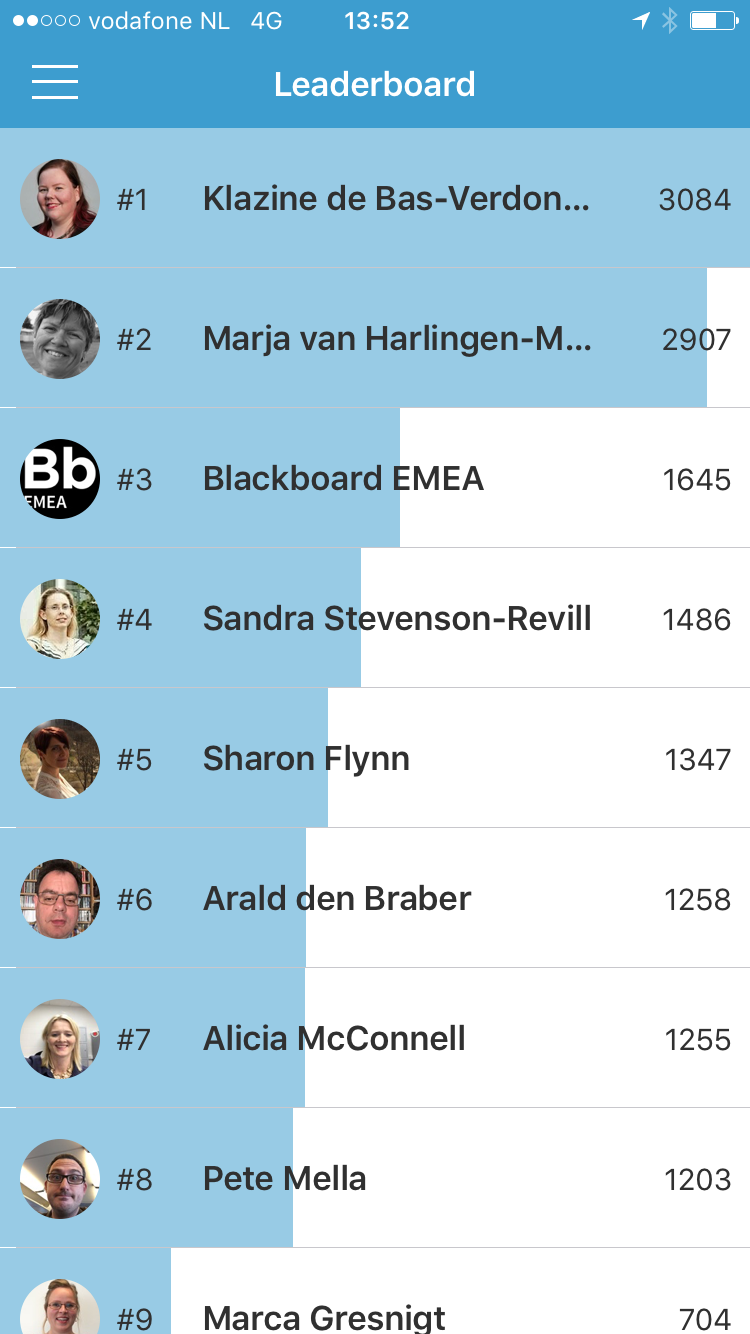
While we were all very busy earning badges, posting pictures of the same powerpoint slide from different angles and distances, we were also earning points. Every activity had an associated point value, though exactly how these were calculated is not clear. Moreover, it was possible to check out the LeaderBoard from within the app. Initially, some of the attendees of DevCon (a pre-conference for developers) were at the top of the board, but before long some of the more competitive types (myself included) started making our way up the board.

It was all a bit of fun. Wasn't it? Until we realised that the activity of "Liking" posts clearly resulted in more points - even Liking your own posts! Something was clearly amiss here. You could barely post anything before it received half a dozen "likes".

At this stage I will state very clearly - I did not start Liking my own updates. Competitition was fierce, though, and it soon became clear that it would not be possible to catch up with the frontrunners.

In the end, I finished a respectable 5th, and I'd like to give a shout out for the two leaders Klazine and Marja who played a very strong game - they left us behind for dust. Kudos also to Pete, Alicia and Sandra - the latter sneaked ahead of me on the last day. What does it say that 13 of the top 20 positions were taken by women?

Final Comments

Certainly the app was useful and fun, and the gamification brought a new community experience to the conference - though possibly not what was intended. It was a shame that the backchannel was closed, but I think this could be easily remedied by improving the ability to publish to twitter at the same time.

The gamification was interesting. How points were allocated is not clear, but it seems that the allocation needs to be rebalanced a little bit, to encourage more activity with added value.

Sunday, 3 April 2016

Preparing for #BbTLC16

Tomorrow I am heading over to Groningen, in The Netherlands, for the annual Blackboard Teaching and Learning Conference. I was last at this conference in Dublin in 2014, when I presented with two students who were developing the NUIG campus app. We won best paper at the event, and went on to present at the Blackboard World Conference in Las Vegas. I have no such ambitions this year - one visit to Las Vegas is more than enough for me!

This year I am travelling a day early, so that I can go along to the Academic Adoption Day on Tuesday, led by Alan Masson. I'm not really sure what to expect, but will blog my experiences.

At the main conference, I'll be presenting, along with Caroline Horan (IT Services at NUIG) about our current Online Results Entry (ORE) project using the Blackboard Grades Journey Tool. For a sneak preview, our prezi is available, though still in development.
RijksUniversiteit Groningen - University of Groningen
 The conference programme is big, with many parallel sessions. I haven't decided which ones to go to, yet. But I will be interested in some of the roadmap talks, and also to meet the new Blackboard CEO Bill Ballhaus. There is a Mobile User Group meeting, also on Thursday. Mostly I'll be interested in finding out about others' use of Blackboard, and picking up some new ideas.

And, of course, I'm looking forward to seeing Groningen, the city, which I've never visited before. The University, where the conference is located, was established in 1614, is part of the Coimbra Group (along with NUI Galway) and graduated Aletta Jacobs the first female to officially attend a Dutch university.

Wednesday, 9 March 2016

"Our Digital Strategy - making IT matter" at #cesicon 2016


I have attended the annual CESI conference for the past five years and it's now become an integral part of my personal CPD. As someone that spent ten years teaching at second level, the event helped me to build my personal learning network (PLN) at a level only matched by participating in CESI's #edchatie Twitter chat session on Monday evenings. Having moved on to NUI Galway, I did ponder how the event I had grown so accustomed to might feel different for me this year.  As more of an observer than a participant, I further shook things up by submitting a presentation.

The conference theme was rooted upon the new "Digital Strategy for Schools 2015 - 2020" document released by the Department of Education.  The document aims to "embed ICT more deeply across the system to enhance the overall quality of Irish education".  This is essentially the same ethos that fuels CESI. Though I've only skimmed the document at this stage, but I can see parallels between it and the National Forum's "Teaching and Learning in Irish Higher Education: A Roadmap for Enhancement in a Digital World 2015-2017".

Professor Mark Brown kick started the morning at DCU with a keynote insisting that we continue to make change and expressing exasperation at the stunted progress on technological innovation in education.  One can only hope the new strategy will address these issues.  He also received resounding applause when he called for coding to become a Leaving Certificate subject.


Professor Mark Brown's Keynote Address


Professor Mark Brown's Keynote Address
Next up was a presentation by Colman Noctor  entitled "Why do we share what we share?" that focused on the purpose of disclosure on social networking sites.  Colman's talk provided food for thought in terms of how young people are affected by the digital world they live in and the expectations of living up to our ideal (online) selves. 


Colman Noctor made us reflect on our online identities


After addressing some technical issues I was having, it was on to Leigh Graves Wolf's  spotlight session on Design Thinking.  Some might know Leigh from her participation in #edchatie and annual GREAT conference at NUI Galway with the Masters in Educational Technology (MAET) at Michigan State University.  Leigh has recently moved into the role of Assistant Director of the MSU Hub for Innovation in Learning and Technology. Leigh's workshop aligned Our Digital Strategy to Design Thinking and had participants brainstorm and tweet/share their thoughts on questions that followed the first two steps of Design Thinking - empathize and define.  If one of the theory's aims is to "make the invisible, visible", then there is no better place to trial it than in front of large group of engaged educators eager to ensure the success of a new Digital Strategy. If we are to ensure the success of such a strategy, we must carefully implement it from the theoretical stages to the beta stages through to the finalized product. In a whirlwind session, Leigh was able to pique participant interest in Design Thinking as well as facilitate a vibrant discussion on the new Digital Strategy.

Leigh Graves Wolf discusses the TPACK model
After lunch it was my turn to present on "Bridging the Gap - Preparing Students for the Expectations of Higher Education".  Like Leigh, I was focusing on current strategies and policies in second level and third level education and aligning the technologies available (and popular) in both sectors that could facilitate an easier transition between the sectors.  In hindsight, it might have been too large a topic for the twenty five minute session, but it certainly helped me to reflect more carefully on an area that I have a vested interest in.

After presenting, I took the time to reconnect with CESI friends from over the years and didn't attend anything else until the National Executive meeting. The most refreshing aspect of CESIcon is the camaraderie and collaboration between the sectors.  It proves that new innovations are adaptable in any educational setting if you maintain an open mind.  If you are interested at all in CESI, I would strongly advise following the #edchatie hashtag on Twitter. Over time, it's easy to build up a strong personal learning network, and you might even be enticed to meet them in person at next year's CESIcon.

You can read about our experience at CESIcon last year on the blog as well.

Thursday, 28 January 2016

Learning from Failure at #durbbu

Earlier this month I made my annual pilgrimmage to Durham to attend the 16th Durham Blackboard Users' Conference. I've been attending this event every January for the last number of years and can honestly say that it's a highlight in my calendar. Even better that it's at the very, very start of the year, meaning I'm not missing too much activity at work, and I can focus my mind completely on the theme of the conference.

Moreover, the annual Durham event is one of the best organised, consistently enjoyable and useful, and the friendliest Ed Tech conference. If Carlsberg did conferences! This is mostly down to the amazing team behind it all, including Malcolm Murray, Julie Mulvey and the Learning Technologies Team at Durham University.

If you are a Blackboard customer in the UK or Ireland (or considering becoming one), you should not miss this annual event. Because it's a Users' conference, it does not have the corporate feel of, say, the Blackboard Teaching and Learning conference. Instead you have the opportunity to hear about and share the real-life experience of fellow Blackboard customers, warts and all. There is also a good representation of staff from Blackboard, giving you great access to raise issues, ask questions and find out about new developments.

Learning from Failure

This year's conference theme was Learning from Failure. It was an excellent theme because this is how most of us learn. It's normal for our efforts to go wrong, but the important thing is to learn from that failure and try again. Even better if we can learn from others' failure, and avoid making the same mistakes ourselves.

We don't often talk about our failures, so I felt privileged to hear about how other people have overcome problems to achieve goals in the use of technologies for teaching and learning.
My notes from the conference extend to several pages. Here I just describe some of the more relevant learnings for me. I did also create a storify from all the tweets from the event, using hastag #durbbu. Some other attendees have written excellent blog posts from the event, which I list at the end of this post.


Bb Student app

I was particularly interested in the launch, in the UK and Ireland, of the new Bb Student mobile app. This is because we've had some particular problems with the current Blackboard Learn mobile app, related to a current (major) project concerning release of grades. The new app, which I write about here, is slicker and more student focused, but unfortunately doesn't solve our problems. This was good for me to learn, if not entirely satisfying.

Collaborate Ultra

We've been hearing about the new Collaborate Ultra product, which will eventually replace the current Collaborate, with the dreaded java download. We have done some testing at NUI Galway, but haven't made the switch, due to limitations in functionality.

However, I was very lucky to hear from Kelly Hall of Edinburgh University about Stepping into the unknown with Collaborate Ultra. Kelly gave a very engaging and informative presentation where she described how 3 groups at Edinburgh have piloted the new system. She was able to identify exactly the limitations and difficulties experienced, but concluded that the groups were overall very happy with Collab Ultra. The main loss of functionality is the ability to create break-out groups, but Blackboard is working on this.

Based on the experience of the pilot, Edinburgh is looking to rollout to Ultra during the summer of 2016. She suggested that case studies, based on the pilot groups, are being compiled and may be made available to those interested.

Enterprise Surveys

I've never really considered Blackboard Enterprise Surveys functionality, because I was under the impression that it was only available as part of the Community System licence. It turns out - I was wrong! After putting the question to twitter, I soon got the response that it is available in the basic, vanilla Learn licence - though clearly turned off in ours.

A presentation from Chris Slack and Adam Tuncay described how they have deployed module quality surveys using different approaches: OMR (Optical Mark Recognition) forms, Blackboard tests, and finally Enterprise Surveys. While there are clearly a lot of challenges in using the Enterprise Survey tool (59 known issues, 3 critical issues) the increase in response rates and the reduction in labour costs were particularly impressive.
Hearing about this project (and its many set-backs) has encouraged me to take a look at Enterprise Surveys on our own environment, some day in the future when I have a bit of time!

Blackboard Updates

The Durham conference always includes a keynote from Blackboard itself, where we can learn something about the current direction and future roadmap for the company. This year, Alan Masson (Head of International Customer Success) gave an engaging keynote reflecting on our shared journey (Blackboard + customers) and what has been learned along the way.

Just two days before the conference, Blackboard had announced that Bill Ballhaus was to succeed Jay Bhatt as CEO.With a new CEO, the focus of the company is likely to shift, so Alan couldn't really say anything about current direction. However, he did speak about some upcoming Roadmap Webinars for the International market. These webinars are a good opportunity to find out more about product strategy, developments and releases.

Alan also pointed us to a new Technology Adoption Guide - 6 Characteristics To Increase Technology Adoption.

Grades Journey Tool

We are currently, at NUI Galway, in the middle of a major institutional project which involves the use of Blackboard's new Grades Journey tool. At the time of the conference, we were on the cusp of rolling out, using a big-bang approach, new grade centre columns to all modules, in all Schools and Colleges, across the University. So, I was particularly interested to hear from Jim Emery from Glasgow Caledonian about his experience of the Grades Journey tool.

Glasgow Caledonian's context is slightly different from ours, albeit with similar goals ultimately. Perhaps very sensibly, GCU is about to commence a pilot of the system, rather than our all-or-nothing approach. His description of the endeavour as a "series of small battles rather than a long war" rang true for me, although I currently feel like I'm involved in a very long war!

Jim's presentation was very honest, as he described his learnings from the project so far. We also spent some time comparing notes on our experiences, which was extremely valuable for me. Jim has written about  Marks Integration, framing it in the context of the Digital University.

Digital Badges

I enjoyed Graham Redshaw-Boxwell's talk about digital badges at Newcastle University and beyond. I think there are plenty of links with the All Aboard project in Ireland, especially the digital badges component of this.

Conclusion

I realise that I'm writing this post three weeks after the conference took place, and I've focused only on those talks that made the most impression on me, in terms of my own learning. I also very much enjoyed Eric Stoller's keynote, about academics and social media.
Unusually for a conference, any of the talks I went to were of high quality, and I learned something new in each one.

Other blog posts about this event include (apologies if I missed any - let me know in the comments):

Learning from Failure – The 16th Durham Blackboard Users’ Conference- Rosie Hare
Reflections on Day 2 of the Blackboard Users’ Conference- Richard Walker
Durham Blackboard Users’ Conference 2016: A Few Reflections - Danny Ball
Learning from Failure…- Maria Tannant
Durbbu - multiple posts by Matt Cornock

Wednesday, 3 June 2015

The Kaltura Connect Education Virtual Summit 2015

The Kaltura Connect Education Virtual Summit took place last week. All the sessions are now available to view on demand, so it you have a little bit of time, head on over to the VOD site to watch.

My own talk User Engagement and Learning Outcomes: How NUI Galway is Changing the way Students Learn Inside and Outside the Classroom is available, though I have brought myself to watch it yet. Hopefully the technical guys worked their magic and I don't look as completely nervous as I actually felt at the time.

The powerpoint slides from the talk are available on Slideshare and embedded here:


Monday, 9 March 2015

Learning at #cesicon 2015

I wasn't sure which identity to bring with me to #cesicon, the annual conference of CESI (Computers in Education Society of Ireland). Billed as an event for those who are interested in integrating technology into their teaching and learning, it seems aimed mostly at first and second level education. Since my professional experience is embedded firmly in higher education, I wasn't sure what benefit the event would be for me.

The free stickers went down well
In my new found interest in all things Wikimedia, however, I wanted to support the Wikimedia Community Ireland group who were presenting in a session called Wikipedia for Education. And so, I signed up as part of An Lucht Vicí. With my new (purple) avatar on twitter, I can no longer hide easily at events, and so I brought along my "me" identity as well.

The one identity that I tried to leave behind was the parent of two children in secondary school. My experience is that parents and teachers don't mix, unless it's at highly structured parent-teacher meetings, organised by the school.

I had a great day, which was full of learning. I was very impressed by the crowds of professionals that attended, mostly primary and secondary teachers, giving up their Saturday to learn and share. I was very impressed by the young people from St Brendan's National School, who were there to sell copies of their newsletter, the Eyrecourt Examiner, and even offered subscriptions and advertising space. It was great to finally meet some twitter friends such as @donenda and @simonmlewis.

And I learned too - more than I expected. Gareth Callan (@gar_callan), from Coláiste Bhaile Chláir, gave a wonderful presentation about flipping the (second level) classroom. To be honest, I wasn't even sure that this was possible at second level in Ireland, but I'm convinced after Gar's talk. After a workshop with Mary Jo Bell (@7MJB) and Ciara Brennan (@PrimEdTeacher), I'm now creating and sharing videos with Vine, and made my first Animoto creation.

The Plenary Panel Discussion was excellent, particularly the young lady who spoke so eloquently about the disconnect between the technology she uses at home and the technology used at school. She asked a simple, but obvious, question: why don't teachers ask their students about what tech they use and might like to use as part of their learning?

By the end of the day, I was tired, but buzzing, especially after John Davitt's very entertaining keynote (talking sheep included). I had come to the realisation that we all have something to learn from each other and it might be no harm to step outside our boundaries occasionally.

But a week later, and as the parent in me reflected, I have a huge sense of regret about the event. My regret is about the teachers who were not there. It's almost 30 years since I did my Leaving Cert (yes, I am that old) and the learning experience of young people at secondary school has not changed significantly since then. I was particularly saddened by a statement over the weekend from one of the teachers' unions, that teachers NOT attend certain CPD opportunities.

Sometimes it's hard to balance multiple identities! Thanks to everyone at #cesicon for your enthusiasm and dedication.

Wednesday, 5 November 2014

Wikipedia Belongs in Education

St Leonard's Hall
The EduWiki 2014 event was held on Friday 31st October in the stunning St Leonard's Hall at the University of Edinburgh. Ever since I heard Toni Sant (Education Organiser with wikimedia UK) speak at the International Integrity and Plagiarism Conference (see previous post), which led me to join the Wikimedia Ireland Community working group, I have been fascinated at the potential of using Wikipedia (and other Wikimedia projects) to support student development in higher education. So, I was thrilled to be at the one day event in Edinburgh to find out more about the Wikimedia UK education projects.

This was always going to be a different crowd from my usual conference network, and there wasn't much tweeting in advance of the event, so I was a little nervous when I turned up at the social event on the evening before the conference. I needn't have worried, the small group that had gathered were as welcoming as could be, including a nacho-eating dog, and several wikipedians. A collection of tweets from the conference and the lead-up was captured using storify by Brian Kelly, who spoke at the event.

Floor Koudijs: Why Wikipedia is great for students
The event itself was opened the next morning by Peter McColl, Rector at the University of Edinburgh, and followed by a presentation from Floor Koudijs from the Wikipedia Education Program at the Wikimedia Foundation.  Her message was a simple one: Wikipedia belongs in Education. Using Wikipedia in the classroom, students will start as readers, but they are future contributors. There followed some discussion about academic staff attitudes to Wikipedia, where it is often not seen as a valid resource. But even academics will use it as a starting point for research, so the suggestion was: instead of fighting it, why not embrace it?

Wikimedia in Education

During the morning, we heard from a number of interesting speakers, including Wikimedians in Residence at various UK institutions including JISC, the Royal Society of Chemistry, and the National Library of Scotland. Of particular interest to me was a presentation from Marc Haynes, former Wikipedian in Residence at Coleg Cymraeg, Wales, which enables teaching through Welsh in the universities in Wales. Marc described his role: working with academics across Welsh universities, training them in wiki editing, sourcing content that could be shared under a suitable Creative Commons licence, and building up content on the Welsh Wicipedia. Since NUIG has a particular responsibility to the Irish language, there would seem to be opportunities to do something similar for Vicipéid, the Irish language wiki. 

Also of immediate interst to me was a very accessible presentation from Martin Poulter, former Wikimedia ambassador at JISC. Martin spoke about his approach to academic staff development around using Wikipedia in education: a Wikipedia comprehension exercise. Rather than starting with how to edit, he demonstrated an approach which highlights academic qualities of Wikimedia articles - the quality scale, citation guidelines, peer review, authorship, collaboration, cultural differences and opportunities for translation projects. Coming at this from the angle of supporting academic integrity, rather than a focus on the technology, is a fantastic approach and one that I hope to use in the future. 

A presentation from Greg Singh, lecturer at the University of Stirling, showed Wikimedia projects in action. I was particularly impressed by the WikiBooks project Digital Media and Culture Yearbook 2014, where students worked in 12 groups of 6, to collaboratively produce an open publication. Marks were awarded for content, understanding and engagement. Student feedback was almost all overwhelmingly positive (11 out of 12 groups).

Beginners Workshop for New Campus Ambassadors and Educators

Instructor Basics
In the afternoon I attended the workshop delivered by Toni Sant and Martin Poulter  for people who are getting started, or thinking of getting started, with Wikipedia in their own institutions. The first part of this was based on the excellent Instructor Basics: How to Use Wikipedia as a Teaching Tool publication. Based on 5 key policies (free content, reliable sources, neutral point of view, notability, good faith), we were led to consider different types of student assignments that can be used to help achieve various learning outcomes. 

Rather than create a new Wikipedia article, which could be quickly removed due to lack of "notability", we were encouraged to think about: translating an article (useful for building up content on Vicipéid, for example); copy editing to improve the grammar or readability of an article; uploading illustrations to Wikimedia Commons on a particular topic or theme; adding new content to an existing article; using Wikidata as the basis of an assignment. Wikipedia also has a number of sister projects that could be used as the basis of students work: Commons, Wikibooks, Wikidata, Wiktionary...

At all times, the importance of interacting with the existing Wikimedia community was stressed, through writing messages on a user's talk page or on an article's talk page. This allows a student to practice skills in collaboration, not just with their classmates, but with a whole world of volunteer editors. 

Of course, students are likely to make mistakes when it comes to Wikipedia etiquette and although we were assured that the majority of Wikipedians will be supportive of fledgling editors, there are also stories of less than helpful behaviours. To support students and educators, we were introduced to the Wikipedia Education Extension which allows educators to register their institution and courses, and within this, identify clearly which articles students may be working on.

There is an impressive amount of online training for educators and for students, and my next step is to become a Campus Ambassador so that I can start to roll out projects at NUI, Galway.

WikiProject Ireland/NUIG National Monuments Editathon Nov 2014 

As a first step, I'm really excited that we are hosting our first An Vicipéid/Wikipedia Editathon this Friday!

Organised by Acadamh na hOllscolaíochta Gaeilge, CELT and the Wikimedia Ireland Community, the aim is to highlight the value of An Vicipéid/Wikipedia as a learning resource and to improve its quality by encouraging Irish traslation students to participate in the event. The event’s theme is The National Monuments of Ireland. This was chosen on account of the Wikimedia Ireland Community’s previous collaboration with the international photography competition Wiki Loves Monuments.

For more information see the event invitation.

No doubt you'll be hearing more about Wikipedia projects at NUIG soon!