Showing posts with label EdTech. Show all posts

Friday, 30 June 2017

Workshop on Learning Design with Prof. Gráinne Conole


I recently had the pleasure of visiting Mary Immaculate College for the first time.  David Maloney from the Blended Learning Unit had organised a workshop on Learning Design with Professor Gráinne Conole, who is currently Visiting Professor at the National Institute of Digital Learning (NIDL) at Dublin City University.

The half day workshop aimed to empower participants to prepare courses for online and mobile environments.  The premise for the workshop, and the design process, stems from Conole's 7 Cs of Learning Design framework:
  • Conceptualise
  • Capture
  • Create
  • Communicate
  • Collaborate
  • Combine
  • Consolidate
Before the crowded room got to any actual design, we were asked to discuss topics such as the challenges posed by technology and how to ruin a course.  It was useful to hear the different angles with which users approached these somewhat loaded topics. I was seated with an educational developer and an academic, which proved to be quite the useful triad.  The educational developer and I, as a learning technologist, were able to work with the academic's course content to complete the exercise like we might do in one of our own training sessions or workshops. Many of the academic staff spoke extensively about how students affect teaching and learning, while so much of the work we do from the support side focuses on how the teacher affects teaching and learning,  

Next on the agenda was a pedagogical features sorting exercise that utilised materials from the Open University Learning Design Initiative (JISC-OULDI) project. Groups were tasked with analysing a course and determining which features were very important, somewhat important or not important. The cards were categorised as:
  • Orange = Guidance and Support
  • Blue = Content and Experience
  • Green = Communication and Collaboration
  • Purple = Reflection and Demonstration.
Participants were soon to realise that everything couldn't be labelled as 'very important'!

It soon became clear to participants that there was a necessity to balancing the categories and choosing pedagogical features carefully in terms of the learning outcomes, course content, platform, and assessment.

In the next exercise, participants were asked to design a typical student that might be taking the course:

Resources for this exercise can be found here.  Overall, the personas were quite specific to the variety of courses on which we were working.  In our case, we created a mature student working in early childhood education undertaking a blended learning course to advance their professional goals.  We assessed our students' technical skills and motivations before moving on to the final portion of the afternoon, creating our course map.
In this exercise, we used the four colours/categories to decide which tools we would use, and what roles/responsibilities correspond to the use of each tool.  I found this part of the day to be useful, as we had to triangulate the roles of teacher, learner and tool.  A recurring theme in our group was modelling of tools by the instructor, both technically and in terms of best use.  We found that communication tools such as discussion boards can often fall flat in terms of student engagement. This can occur as a result of a lack of exemplar content, rubrics, or modelling by the instructor.  We decided that students needed to see for themselves how the tool could help them learn, and not just earn easy points for participation.

While this might have been a whirlwind session, there was much to take away in terms of the relationship between the course, pedagogy, learner, and tools.  Events like this remind us to be cognizant of the many facets of learning design.  We must think about processes, relationships, skills, and attitudes.  Thank you again to David and his colleagues at Mary Immaculate College for hosting, and thank you to Prof. Conole for providing us with resources to use in the future.

Monday, 19 June 2017

ILTA EdTech 2017 Conference - TEL in an Age of Supercomplexity Challenges, Opportunities and Strategies


As our own CELT Symposium looms at the end of the week, it seems fitting that I finally reflect on the last conference I attended.  

This year's EdTech theme allowed us to pause and reflect about TEL in a complex age. Throughout the two day event, it was evident that we are indeed facing challenges, but also using those challenges to create strategies and opportunities.  

The first keynote of day one was from Gráinne Conole, who is currently a visiting professor at DCU. She focused on the future of learning and harnessing technologies.  Her presentation encompassed so much of the landscape and set the scene well for what was to come.  In discussing the characteristics of the 21st century learner, necessary digital literacies, the integration of OERs, structures of MOOCS, and the benefits for students; she arrived at a heutagogical approach that allows students more affordances in the Web 2.0 landscape. 
In summation, she called on us to rigorously approach learning design, to harness the power of analytics, and implement pedagogies that support the supercomplexity of the future.  Her slides can be found here:

The next session that I attended, Assessment and Feedback in the Digital Age, was rife with ideas, but one in particular stood out to me.  Mark Glynn from DCU posed a simple idea:

I really appreciated how such a nuanced idea could sum up the whole TEL landscape so succinctly.  It's clear that even in our terminology we can accidentally place the focus on the technology rather than the pedagogy.

The Global Challenges in Higher Education session was led by Lawrie Phipps and Donna Lanclos. The discussed Leading with Digital in an Age of Supercomplexity, and namely on the JISC Digital Leaders programme. As a bit of a fan, I get presumptuously excited that Donna was in Sligo, but I was to be disappointed.
At the same time, I unfortunately missed Mary Loftus speaking about her work on learning analytics, but her slides are available here:

The second keynote from Professor Paul J. LeBlanc, President of Southern New Hampshire University.  He discussed the success of competency based learning at SNHU. He also joked that Americans don't talk about MOOCs as much as the Irish do at an ed tech conference!
The Jennifer Burke award went to Antonio Calderón of UL for a fantastic project with initial teacher educators in PE.  This project, #CoolPE, is definitely worth looking at, as it could be adapted across sectors and subject areas.
On a beautiful Friday morning, we launched into day two of the conference.

Mark Glynn outlined Turning off Turnitin.  This might sound like a frightening challenge, but Mark was open and candid about the process, and the difficulties they faced.
Niall Watts from UCD, again quite candidly, discussed the creation and use of MOOCs in first year Geography to largely positive feedback from students. His slides can be accessed here.
I unfortunately missed our NUI Galway colleague, Bonnie Long, talk about the Flipping the Flipped Classroom:
One stand out presentation for me was from Sam Cogan of the National College of Ireland, who discussed dual delivery in his lectures.  I've flagged this one for follow up, as he seems to be actively and progressively focused on changing the dynamics of the lecture hall.
Professor Meg Benke's keynote was refreshing in its reflective nature and its focus on scholarship through the work of Boyer.  She discussed the importance of education, communities of practice, and new methodologies in the age of supercomplexity.

It was also announced that ILTA would co-sponsor ten people going forward for CMALT certification.
In closing, ILTA made a call for members to get involved in the coming year.  It should also be noted that submissions are welcome for the Irish Journal of Technology Enhanced Learning.
Reflecting on the two days, it's evident that in age where we as practitioners are faced with complex challenges, that we must remain vigilant and become involved, reflective, and active practitioners. The keynote speakers and presenters at this year's conference are working through challenges and planning for an uncertain future, while focusing on learning and success that is only enhanced through technology.

And on a final note, videos will be available soon!


Monday, 26 January 2015

The Really Useful #EdTechBook and my small part in it

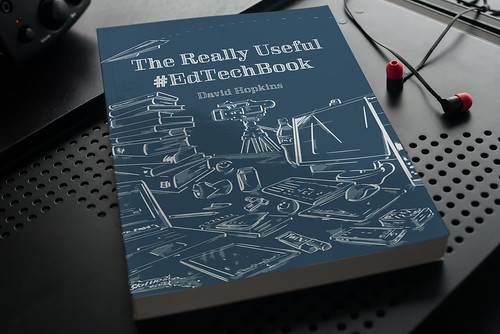
The Really Useful #EdTechBookWay back in July/August 2014, David Hopkins (@hopkinsdavid) approached a number of people involved in EdTech, myself included, about an idea he had to collaboratively write a Really Useful EdTech Book. The book is now available for download and will be published on proper paper within the next couple of days.

To find out more about it, and to download your copy, visit David's blog. It's a fabulous collection of chapters from practitioners, researchers and professionals in the area of EdTech, and has a foreword by our own Catherine Cronin. There are some very positive reviews already on this site, including one from Steve Wheeler.

David has done an amazing job in bringing this all together. I don't know about the other authors but I don't think I met a single deadline. His patience is beyond belief, and he still seems to be talking to me!

For me, it was a great opportunity to be part of such a collaboration, which includes some people that I know quite well from twitter, one or two that I've actually met in person, and some others that I'm just getting to know.

One part of the whole process that I particularly enjoyed was being "interviewed" by David back in October. Using a google doc to support communication, David put questions to me and I responded. As it turns out, I was travelling at the time, so it was a great opportunity to really use google docs on a collaborative project. The interview was published in November.

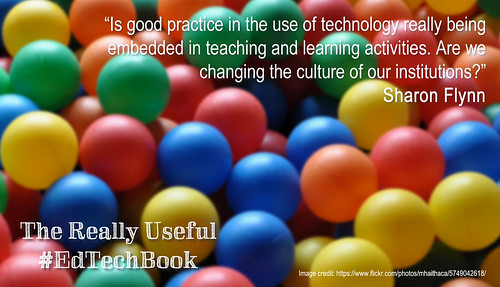
The Really Useful #EdTechBook, quote by Sharon Flynn It also gave me a chance to reflect on the topic of my own chapter, which asks if the work of the learning technologist is having any long term effects on the culture of the university. While we can "measure" our productivity in terms of numbers of workshops, numbers of people trained, support tickets closed, projects brought to completion, etc, how do we know if we're making a longer term impact?

I'd really like to thank David Hopkins for including me in this collaboration. It has been an exciting and novel experience. I think we can all be proud of the Really Useful #EdTechBook.


Wednesday, 8 August 2012

Creating video for teaching

Using video in your teaching can be a great way to get a message across and to enhance student engagement. There are some great videos available on YouTube, iTunesU or TED Talks, for example, that can be used to illustrate a concept or give additional information.

In the last year, we've seen an increase in the number of academic staff who are creating their own videos for use in teaching. See, for example, the NUI Galway Microbiology channel on YouTube, Derek Molloy's (DCU) award-winning channel on Digital Electronics, or setting up the oscilloscope in a Physics lab.

Certainly, recording something on my mobile phone and uploading it to YouTube is surprisingly easy. But how easy is it to create something a little bit more professional and useful for teaching purposes?

With these questions in mind, I went along to Irene McCormick's presentation at the EdTech conference in Maynooth in May. Irene is from IT Carlow and she is responsible for this NDLR-funded video, illustrating why you might want to use a tripod when recording video.


At her presentation, Irene gave some compelling reasons why we might want to bother with video: that it supports innovative methods of teaching, learning and assessment; it's good for our own professional development; it can involve students, particularly where they are producing video; and it can be good fun!

She stressed some important points, the main one being Keep It Simple. Don't use gimmicks, stick to the storyline and aim for high levels of continuity.

Creating video involves three stages. The planning stage is the most important to get right - never go out with a camera and start filming. Consider equipment, your team, dates, locations, actors and whether there is any A/V support available. Write a script. Irene recommends using something like celtx, which I will have to investigate.

The second stage is production, where you actually get out with your video camera. Again, Irene recommends a simple approach: no need for zooming; work methodically; and use a tripod.

The final stage is post-production, where you edit your video. Again, this can be kept very simple; no complicated transitions. Irene recommends Final Cut Pro, but if you're just starting out, Windows MovieMaker does pretty much everything you need (and it's free).

If you're based at NUI Galway, you can use our Kaltura connector on Blackboard to upload your final masterpiece to Blackboard for your students' consumption. Otherwise, YouTube, BlipTV or Vimeo are all possibilities for hosting video in the cloud.

Monday, 18 June 2012

Learning about Digital Literacies at EdTech 2012

The last couple of weeks have been busy, between the EdTech 2012 conference organised by ILTA, our own CELT conference, and then a presentation to the WRSLAI event last week. I haven't had time to think!

So, before my memories fade completely, I'll write a couple of blog posts about all these events. I'm starting with the keynote speakers at EdTech 2012, compiled from my notes and tweets, using storify.