 |
| St Leonard's Hall |
The
EduWiki 2014 event was held on Friday 31st October in the stunning St Leonard's Hall at the University of Edinburgh. Ever since I heard Toni Sant (Education Organiser with wikimedia UK) speak at the
International Integrity and Plagiarism Conference (
see previous post), which led me to join the
Wikimedia Ireland Community working group, I have been fascinated at the potential of using Wikipedia (and other Wikimedia projects) to support student development in higher education. So, I was thrilled to be at the one day event in Edinburgh to find out more about the Wikimedia UK education projects.
This was always going to be a different crowd from my usual conference network, and there wasn't much tweeting in advance of the event, so I was a little nervous when I turned up at the social event on the evening before the conference. I needn't have worried, the small group that had gathered were as welcoming as could be, including a nacho-eating dog, and several wikipedians. A
collection of tweets from the conference and the lead-up was captured using storify by
Brian Kelly, who spoke at the event.
 |
| Floor Koudijs: Why Wikipedia is great for students |
The event itself was opened the next morning by
Peter McColl, Rector at the University of Edinburgh, and followed by a presentation from
Floor Koudijs from the Wikipedia Education Program at the Wikimedia Foundation. Her message was a simple one:
Wikipedia belongs in Education. Using Wikipedia in the classroom, students will start as readers, but they are future contributors. There followed some discussion about academic staff attitudes to Wikipedia, where it is often not seen as a valid resource. But even academics will use it as a starting point for research, so the suggestion was: instead of fighting it, why not embrace it?
Wikimedia in Education
During the morning, we heard from a number of interesting speakers, including
Wikimedians in Residence at various UK institutions including JISC, the Royal Society of Chemistry, and the National Library of Scotland. Of particular interest to me was a presentation from Marc Haynes, former Wikipedian in Residence at Coleg Cymraeg, Wales, which enables teaching through Welsh in the universities in Wales. Marc described his role: working with academics across Welsh universities, training them in wiki editing, sourcing content that could be shared under a suitable Creative Commons licence, and building up content on the Welsh Wicipedia. Since NUIG has a particular responsibility to the Irish language, there would seem to be opportunities to do something similar for Vicipéid, the Irish language wiki.
Also of immediate interst to me was a very accessible presentation from
Martin Poulter, former Wikimedia ambassador at JISC. Martin spoke about his approach to academic staff development around using Wikipedia in education: a
Wikipedia comprehension exercise. Rather than starting with how to edit, he demonstrated an approach which highlights academic qualities of Wikimedia articles - the quality scale, citation guidelines, peer review, authorship, collaboration, cultural differences and opportunities for translation projects. Coming at this from the angle of supporting academic integrity, rather than a focus on the technology, is a fantastic approach and one that I hope to use in the future.
A presentation from
Greg Singh, lecturer at the University of Stirling, showed Wikimedia projects in action. I was particularly impressed by the WikiBooks project
Digital Media and Culture Yearbook 2014, where students worked in 12 groups of 6, to collaboratively produce an open publication. Marks were awarded for content, understanding and engagement. Student feedback was almost all overwhelmingly positive (11 out of 12 groups).
Beginners Workshop for New Campus Ambassadors and Educators
 |
| Instructor Basics |
In the afternoon I attended the workshop delivered by Toni Sant and Martin Poulter for people who are getting started, or thinking of getting started, with Wikipedia in their own institutions. The first part of this was based on the excellent
Instructor Basics: How to Use Wikipedia as a Teaching Tool publication. Based on 5 key policies (free content, reliable sources, neutral point of view, notability, good faith), we were led to consider different types of student assignments that can be used to help achieve various learning outcomes.
Rather than create a new Wikipedia article, which could be quickly removed due to lack of "
notability", we were encouraged to think about: translating an article (useful for building up content on Vicipéid, for example); copy editing to improve the grammar or readability of an article; uploading illustrations to Wikimedia Commons on a particular topic or theme; adding new content to an existing article; using Wikidata as the basis of an assignment. Wikipedia also has a number of sister projects that could be used as the basis of students work: Commons, Wikibooks, Wikidata, Wiktionary...
At all times, the importance of interacting with the existing Wikimedia community was stressed, through writing messages on a user's talk page or on an article's talk page. This allows a student to practice skills in collaboration, not just with their classmates, but with a whole world of volunteer editors.
Of course, students are likely to make mistakes when it comes to Wikipedia etiquette and although we were assured that the majority of Wikipedians will be supportive of fledgling editors, there are also stories of less than helpful behaviours. To support students and educators, we were introduced to the
Wikipedia Education Extension which allows educators to register their institution and courses, and within this, identify clearly which articles students may be working on.
There is an impressive amount of online training
for educators and
for students, and my next step is to become a
Campus Ambassador so that I can start to roll out projects at NUI, Galway.
WikiProject Ireland/NUIG National Monuments Editathon Nov 2014
As a first step, I'm really excited that we are hosting
our first An Vicipéid/Wikipedia Editathon this Friday!
Organised by Acadamh na hOllscolaíochta Gaeilge, CELT and the Wikimedia Ireland Community, the aim is to highlight the value of An Vicipéid/Wikipedia as a learning resource and to improve its quality by encouraging Irish traslation students to participate in the event. The event’s theme is
The National Monuments of Ireland. This was chosen on account of the Wikimedia Ireland Community’s previous collaboration with the international photography competition Wiki Loves Monuments.
For more information see the
event invitation.
No doubt you'll be hearing more about Wikipedia projects at NUIG soon!

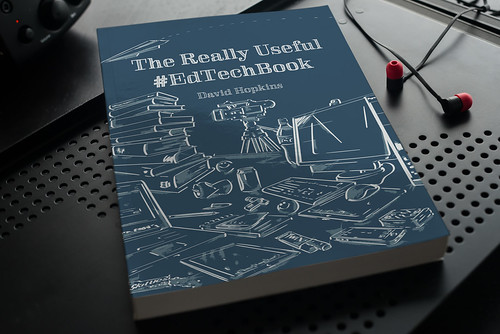 Way back in July/August 2014, David Hopkins (@hopkinsdavid) approached a number of people involved in EdTech, myself included, about an idea he had to collaboratively write a Really Useful EdTech Book. The book is now available for download and will be published on proper paper within the next couple of days.
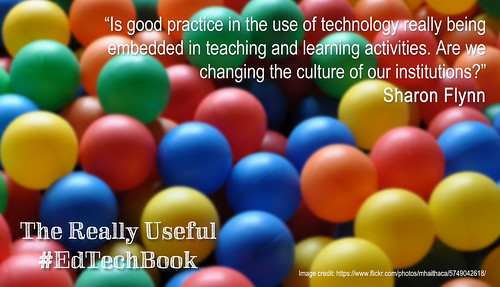 It also gave me a chance to reflect on the topic of my own chapter, which asks if the work of the learning technologist is having any long term effects on the culture of the university. While we can "measure" our productivity in terms of numbers of workshops, numbers of people trained, support tickets closed, projects brought to completion, etc, how do we know if we're making a longer term impact?

