Showing posts with label Blackboard. Show all posts

Thursday, 19 May 2016

#BbTLC16 Report - Blackboard product updates

I've been very remiss in my reports from #BbTLC16, which happened at the beginning of April. But I still have my notes from the sessions, intending to write them up.


On Tuesday I sat in on the Blackboard International Product Update Webinar - which covered similar ground to the product update sessions at #BbTLC16 - so I thought I'd take the opportunity to put a few sentences together.

The webinar covered three main products: Blackboard Learn, Collaborate Ultra, and mobile solutions Bb Student and Bb Instructor.

Blackboard Learn

Wade Weichel gave a presentation (at both #BbTLC16 and on the webinar) about the roadmap for the classic VLE. Apparently the focus is to make the learner's experience "more delightful".

flickr photo by Pleuntje https://flickr.com/photos/pleuntje/3456892561 shared under a Creative Commons (BY-SA) license

Blackboard are moving to a regular update schedule, with two major releases each year, and cumulative updates in-between. Q2 2016 was released last month, and brings increased stability to the system - which is good news. There was a lot of talk about infrastructure and authentication, which went over my head, but one piece of advice is to test all (non Blackboard) building blocks (for example, Turnitin), on a test environment, to ensure that they work properly, prior to upgrade on a production environment.

The old chat and virtual classrooms are being discontinued - although we disabled these on our system some time ago. Otherwise, there are some accessibility improvements and a reply capability on emails.

The Ultra experience for Learn, which was touted at BbWorld in 2014 and again at the Education on Tour event in Dublin that year, was not mentioned at all. Instead we heard about a new theme for 9.1, which would include some responsive design features. Last month I wondered if this would be ready in time to test and apply before our new academic year (starting in early September). However, from today's webinar it seems that this is still in development, and updates will be provided in future webinars.

Finally, admin-level course activity overview reports, which sound really useful, are also still in development.

Collaborate Ultra

Like many institutions, we are currently running both versions of Collaborate (classic and Ultra), but haven't made the switch to Ultra from within the VLE yet. This is because the functionality within Ultra does not yet match that of the classic version (see my notes on this from #durbbu). However, it's clear that Collab Ultra is being developed quickly, with updates being released regularly.

A view of Collab Ultra, taken at #BbTLC16

Carl Marelli gave an update on Collaborate Ultra. The biggest advantage of Ultra is the lack of a Java download - anybody can participate directly in the browser (preferably Chrome). Ultra is described as "delightful and modern". Other features that have been recently added include:
  • the maximum number of participants has increased to 100, and will further increase to 250;
  • uploaded files (powerpoint, pdf etc) now persist within a Collab room
  • increased video and audio quality
  • accessibility features
  • MP4 recordings
  • integration with Bb student
Coming soon will be breakout groups and group chats, while polling features are still in development.

An improved integration with Learn is also being developed, so that instructors can choose whether to switch to Ultra or stay with the classic version (depending on their use case).

Mobile

Dan Loury gave an update on the mobile strategy for Blackboard. The original mobile app, Blackboard Mobile Learn, is being replaced by two persona driven apps - one for students and one for instructors. Bb Student was launched in the UK and Ireland in January, and I wrote about it at the time. We've since had some limited feedback from students on the app, but for the most part I suspect students at NUIG are still using Mobile Learn.

Since January, development has continued on the app, and it now includes notifications - which is a feature much in demand from students.

Future releases will include discussion boards and the ability to join a Collaborate Ultra session from the app - these features are currently in beta. In development is the ability for app-to-app launches, which will mean that we can embed Bb Student in our NUIG Mosaic app.

A little further away is the launch of a Bb Instructor app, which will replace the current Bb Grader. This will be available for tablets only, initially.

Keeping Informed

It is good to see Blackboard continue to develop the various tools, but sometimes important new features become available without us being aware of them. The events can be useful to find out about these, but often we are too caught up in the general day-to-day activities to realise that there is something new to think about.

The webinars are good opportunities for a quick overview of developments. One tip is to always sign up for the webinar; even if you can't make it at the time, you will receive a link to the recording.

Another relatively new initiative is the Innovate&Educate monthly newsletter, for which you can sign up here.

Sign up for the newsletter


Sunday, 17 April 2016

Gamification at #BbTLC16

Earlier this month I was at #BbTLC16 - the annual Blackboard Teaching & Learning conference, which took place in Groningen this year. I've been meaning to write a couple of blog posts about it, and what I learned there, but have been so busy since I got back! That's the downside of being at a conference, work just piles up and waits for you to return.


One of the interesting features of the conference this year was the use of the mobile app, which we were encouraged to download prior to the event.

As well as easy access to the programme, and the ability to build up a personal agenda, there were a couple of other features that added to conference experience (positive and negative) and ultimately had an affect on my behaviour as part of the backchannel, as well as others.

Mobile Agenda

There was (initially) no printed programme available at the conference. The online programme was a little tricky to navigate, with up to 6 parallel sessions each day, and I certainly didn't pay it much attention before travelling. So it was extremely useful to be able to browse the programme using the app. Each session had a very short description, or you could browse by speaker, and add talks of interest to a personal agenda. If you allowed notifications, you would even get a reminder when a particular talk was about to start. With my increasing reliance on online calendars, this proved to be a very useful feature.

This is where the gamification starts. Once in a particular session, you then had an option to "check-in", allowing you to collect points. When a session finished, you were presented with an option to rate (out of 5) and make comments on the talk. Each of these activities allowed you to collect further points. It's not entirely clear where the ratings and comments went - but presumably the conference organisers are using them in some way. As a speaker, I certainly have not seen any feedback on our presentation.

Community

On first accessing the app, I was encouraged to create a profile, linking it to my LinkedIn, twitter and/or Facebook accounts. I used the opportunity to link to LinkedIn and twitter, but my Facebook activity is much more personal.

Within the app, it was possible to browse all Attendees (and separately all Speakers), including Blackboard personel and other sponsors, thus finding out a little more about them, and also see what networks they had shared. This was very useful for following up on new acquaintances, leading to some new LinkedIn connections and Twitter followers.

Activity

Now things start getting interesting! One of the main features, once the conference started, was the activity feed. Like a conference twitter feed, users of the app could post updates, with links, pictures and videos. We could also "like" posts and even comment on them. Before long, we realised that we could earn badges by posting, commenting, rating, checking-in. I managed to get 22 out of 27 possible badges!

Posting to the activity feed became an obsession. While it should have been possible to send everything to Twitter as well, this didn't really happen. I had no success posting to Twitter at all, while photos were missing from other people's tweets. This meant that the (public) activity using the #BbTLC16 hashtag was not particularly active. For my part, I did try to tweet some of the announcements that were made, but it was awkward to keep the activity going in two places, as well as trying to take notes. The very active backchannel that was happening around the conference was enclosed within the app, behind closed doors.

As with most conference backchannels, it was very useful to find out what was going on in another parallel session. Images, updates and comments, especially those from particular individuals, could really give a sense of what was being discussed, and it was possible to join in a conversation from another room, or to follow up with particular speakers or attendees during the networking breaks.

The LeaderBoard

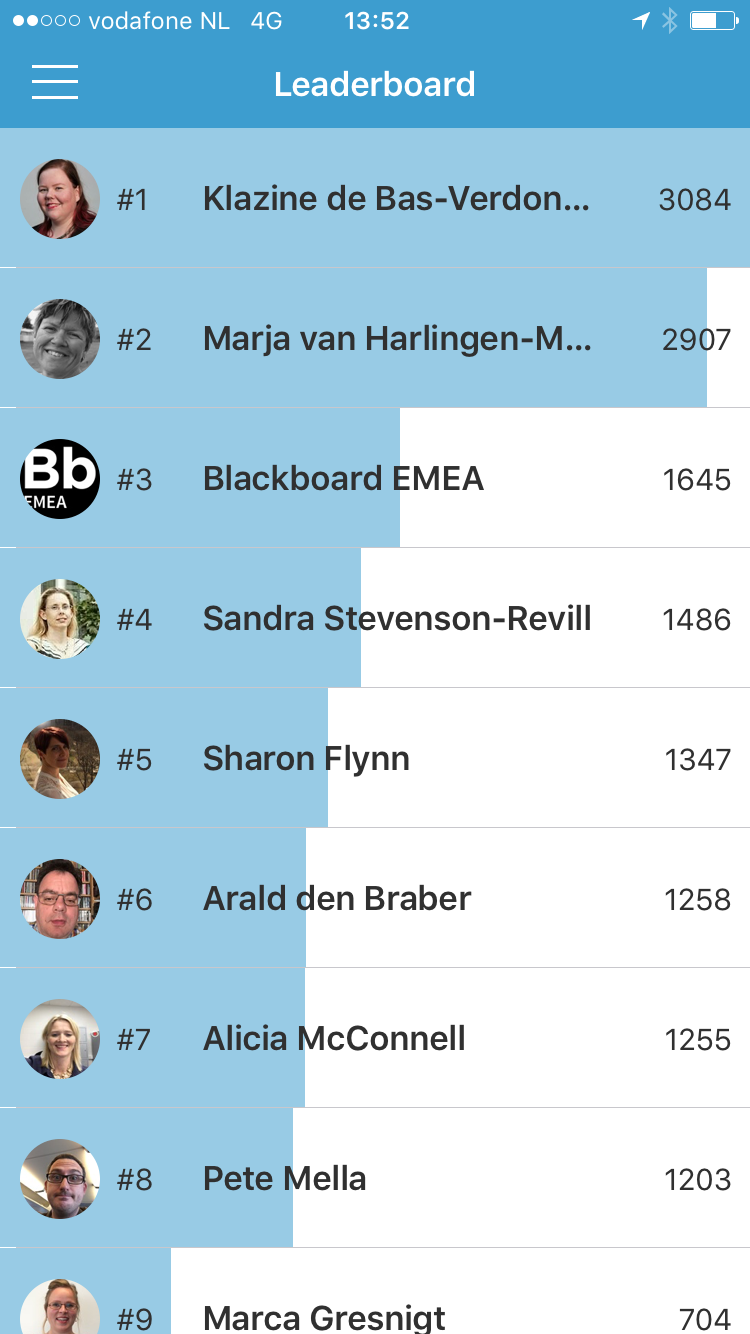
While we were all very busy earning badges, posting pictures of the same powerpoint slide from different angles and distances, we were also earning points. Every activity had an associated point value, though exactly how these were calculated is not clear. Moreover, it was possible to check out the LeaderBoard from within the app. Initially, some of the attendees of DevCon (a pre-conference for developers) were at the top of the board, but before long some of the more competitive types (myself included) started making our way up the board.

It was all a bit of fun. Wasn't it? Until we realised that the activity of "Liking" posts clearly resulted in more points - even Liking your own posts! Something was clearly amiss here. You could barely post anything before it received half a dozen "likes".

At this stage I will state very clearly - I did not start Liking my own updates. Competitition was fierce, though, and it soon became clear that it would not be possible to catch up with the frontrunners.

In the end, I finished a respectable 5th, and I'd like to give a shout out for the two leaders Klazine and Marja who played a very strong game - they left us behind for dust. Kudos also to Pete, Alicia and Sandra - the latter sneaked ahead of me on the last day. What does it say that 13 of the top 20 positions were taken by women?

Final Comments

Certainly the app was useful and fun, and the gamification brought a new community experience to the conference - though possibly not what was intended. It was a shame that the backchannel was closed, but I think this could be easily remedied by improving the ability to publish to twitter at the same time.

The gamification was interesting. How points were allocated is not clear, but it seems that the allocation needs to be rebalanced a little bit, to encourage more activity with added value.

Sunday, 3 April 2016

Preparing for #BbTLC16

Tomorrow I am heading over to Groningen, in The Netherlands, for the annual Blackboard Teaching and Learning Conference. I was last at this conference in Dublin in 2014, when I presented with two students who were developing the NUIG campus app. We won best paper at the event, and went on to present at the Blackboard World Conference in Las Vegas. I have no such ambitions this year - one visit to Las Vegas is more than enough for me!

This year I am travelling a day early, so that I can go along to the Academic Adoption Day on Tuesday, led by Alan Masson. I'm not really sure what to expect, but will blog my experiences.

At the main conference, I'll be presenting, along with Caroline Horan (IT Services at NUIG) about our current Online Results Entry (ORE) project using the Blackboard Grades Journey Tool. For a sneak preview, our prezi is available, though still in development.
RijksUniversiteit Groningen - University of Groningen
 The conference programme is big, with many parallel sessions. I haven't decided which ones to go to, yet. But I will be interested in some of the roadmap talks, and also to meet the new Blackboard CEO Bill Ballhaus. There is a Mobile User Group meeting, also on Thursday. Mostly I'll be interested in finding out about others' use of Blackboard, and picking up some new ideas.

And, of course, I'm looking forward to seeing Groningen, the city, which I've never visited before. The University, where the conference is located, was established in 1614, is part of the Coimbra Group (along with NUI Galway) and graduated Aletta Jacobs the first female to officially attend a Dutch university.

Thursday, 28 January 2016

Learning from Failure at #durbbu

Earlier this month I made my annual pilgrimmage to Durham to attend the 16th Durham Blackboard Users' Conference. I've been attending this event every January for the last number of years and can honestly say that it's a highlight in my calendar. Even better that it's at the very, very start of the year, meaning I'm not missing too much activity at work, and I can focus my mind completely on the theme of the conference.

Moreover, the annual Durham event is one of the best organised, consistently enjoyable and useful, and the friendliest Ed Tech conference. If Carlsberg did conferences! This is mostly down to the amazing team behind it all, including Malcolm Murray, Julie Mulvey and the Learning Technologies Team at Durham University.

If you are a Blackboard customer in the UK or Ireland (or considering becoming one), you should not miss this annual event. Because it's a Users' conference, it does not have the corporate feel of, say, the Blackboard Teaching and Learning conference. Instead you have the opportunity to hear about and share the real-life experience of fellow Blackboard customers, warts and all. There is also a good representation of staff from Blackboard, giving you great access to raise issues, ask questions and find out about new developments.

Learning from Failure

This year's conference theme was Learning from Failure. It was an excellent theme because this is how most of us learn. It's normal for our efforts to go wrong, but the important thing is to learn from that failure and try again. Even better if we can learn from others' failure, and avoid making the same mistakes ourselves.

We don't often talk about our failures, so I felt privileged to hear about how other people have overcome problems to achieve goals in the use of technologies for teaching and learning.
My notes from the conference extend to several pages. Here I just describe some of the more relevant learnings for me. I did also create a storify from all the tweets from the event, using hastag #durbbu. Some other attendees have written excellent blog posts from the event, which I list at the end of this post.


Bb Student app

I was particularly interested in the launch, in the UK and Ireland, of the new Bb Student mobile app. This is because we've had some particular problems with the current Blackboard Learn mobile app, related to a current (major) project concerning release of grades. The new app, which I write about here, is slicker and more student focused, but unfortunately doesn't solve our problems. This was good for me to learn, if not entirely satisfying.

Collaborate Ultra

We've been hearing about the new Collaborate Ultra product, which will eventually replace the current Collaborate, with the dreaded java download. We have done some testing at NUI Galway, but haven't made the switch, due to limitations in functionality.

However, I was very lucky to hear from Kelly Hall of Edinburgh University about Stepping into the unknown with Collaborate Ultra. Kelly gave a very engaging and informative presentation where she described how 3 groups at Edinburgh have piloted the new system. She was able to identify exactly the limitations and difficulties experienced, but concluded that the groups were overall very happy with Collab Ultra. The main loss of functionality is the ability to create break-out groups, but Blackboard is working on this.

Based on the experience of the pilot, Edinburgh is looking to rollout to Ultra during the summer of 2016. She suggested that case studies, based on the pilot groups, are being compiled and may be made available to those interested.

Enterprise Surveys

I've never really considered Blackboard Enterprise Surveys functionality, because I was under the impression that it was only available as part of the Community System licence. It turns out - I was wrong! After putting the question to twitter, I soon got the response that it is available in the basic, vanilla Learn licence - though clearly turned off in ours.

A presentation from Chris Slack and Adam Tuncay described how they have deployed module quality surveys using different approaches: OMR (Optical Mark Recognition) forms, Blackboard tests, and finally Enterprise Surveys. While there are clearly a lot of challenges in using the Enterprise Survey tool (59 known issues, 3 critical issues) the increase in response rates and the reduction in labour costs were particularly impressive.
Hearing about this project (and its many set-backs) has encouraged me to take a look at Enterprise Surveys on our own environment, some day in the future when I have a bit of time!

Blackboard Updates

The Durham conference always includes a keynote from Blackboard itself, where we can learn something about the current direction and future roadmap for the company. This year, Alan Masson (Head of International Customer Success) gave an engaging keynote reflecting on our shared journey (Blackboard + customers) and what has been learned along the way.

Just two days before the conference, Blackboard had announced that Bill Ballhaus was to succeed Jay Bhatt as CEO.With a new CEO, the focus of the company is likely to shift, so Alan couldn't really say anything about current direction. However, he did speak about some upcoming Roadmap Webinars for the International market. These webinars are a good opportunity to find out more about product strategy, developments and releases.

Alan also pointed us to a new Technology Adoption Guide - 6 Characteristics To Increase Technology Adoption.

Grades Journey Tool

We are currently, at NUI Galway, in the middle of a major institutional project which involves the use of Blackboard's new Grades Journey tool. At the time of the conference, we were on the cusp of rolling out, using a big-bang approach, new grade centre columns to all modules, in all Schools and Colleges, across the University. So, I was particularly interested to hear from Jim Emery from Glasgow Caledonian about his experience of the Grades Journey tool.

Glasgow Caledonian's context is slightly different from ours, albeit with similar goals ultimately. Perhaps very sensibly, GCU is about to commence a pilot of the system, rather than our all-or-nothing approach. His description of the endeavour as a "series of small battles rather than a long war" rang true for me, although I currently feel like I'm involved in a very long war!

Jim's presentation was very honest, as he described his learnings from the project so far. We also spent some time comparing notes on our experiences, which was extremely valuable for me. Jim has written about  Marks Integration, framing it in the context of the Digital University.

Digital Badges

I enjoyed Graham Redshaw-Boxwell's talk about digital badges at Newcastle University and beyond. I think there are plenty of links with the All Aboard project in Ireland, especially the digital badges component of this.

Conclusion

I realise that I'm writing this post three weeks after the conference took place, and I've focused only on those talks that made the most impression on me, in terms of my own learning. I also very much enjoyed Eric Stoller's keynote, about academics and social media.
Unusually for a conference, any of the talks I went to were of high quality, and I learned something new in each one.

Other blog posts about this event include (apologies if I missed any - let me know in the comments):

Learning from Failure – The 16th Durham Blackboard Users’ Conference- Rosie Hare
Reflections on Day 2 of the Blackboard Users’ Conference- Richard Walker
Durham Blackboard Users’ Conference 2016: A Few Reflections - Danny Ball
Learning from Failure…- Maria Tannant
Durbbu - multiple posts by Matt Cornock

Wednesday, 12 November 2014

Blackboard Education on Tour comes to Dublin


This is a brief report from the Blackboard Education on Tour event which took place in Dublin last week, on Tuesday 4th November. First of all, I'd like to mention that the Irish user community really appreciated that Blackboard included Dublin in its tour, making it so much easier for us to attend. It was good to see such a great turnout from various Irish Institutions.

The programme for the day included 2 tracks: Product Discussion and Professional Development. I'd have loved to get to some of the Professional Development sessions, but because I was the only one from NUIG, I decided to stay in the Product Discussion track.

The event was opened by Demetra Katsifli who welcomed everybody to the event and spoke about Blackboard's development priorities for the EMEA region and some specific examples of where Irish/UK requests have influenced product design. The big one here is delegated and anonymous marking, which is starting to be addressed in the April 2014 release. She also mentioned the particular problem that we've experienced, the Irish language character set and how it works in Collaborate (hint: not very well). The good news is that they've fixed the issue for á, but we're still waiting for ú to be addressed.

Leading the evolution of learning delivery
Demetra then introduced the keynote for the morning, Brad Koch, Vice President for Product Management. Brad spoke about Blackboard's Vision (a world inspired to learn) and Mission (to reimagine education). His talk was very much in keeping with the message that Blackboard has been developing and communicating for the last year, and clearly influenced by Jay Bhatt, Blackboard CEO. See my notes from BbWorld14 and the Blackboard Teaching and Learning conference in Dublin earlier this year for more on this message.


Rather than go through each session in detail, I'll give an overview from my notes on each development/innovation.

Blackboard Learn SaaS
During his keynote at BbWorld14, Jay Bhatt announced that Blackboard is moving into the cloud. This means that Blackboard Learn can be implemented on one of three platforms: self hosted; managed hosted (in Amsterdam for us); or in the cloud SaaS. For cloud installations there are some specific advantages, including zero downtime for upgrades, scalable resource allocation, and protection from Denial of Services attacks. It appears that all managed hosted environments will eventually be moved into the cloud, but it's not clear what are the cost implications for an institution.

Support for MOOCs
Blackboard's open education platform openeducation.blackboard.com is now available and can be used at no charge by any Blackboard institution. It uses the SaaS platform. An institution can request an institutional account through their client manager.

Mobile
A new Mobile Learn for students is in design and will be available for iOS, Android and Windows. Functionality for instructors has never been supported in the app, so two separate apps will be developed, one for students and one for instructors, reflecting different workflows.

Blackboard's first app aimed at instructors is now available and works with any Learn installation running the April 2014 release (or higher). It is currently being localised from the US version to one that is more consistent with Irish/UK terminology.

The app (available for iPad only) will allow instructors to grade student assignment submissions using rubrics, and facilitates voice and video feedback. It also includes an individual risk profile for each student, which can be customised. Students at risk can be emailed from directly within the app.

Unfortunately it requires a data connection. Otherwise it looks like it will be a useful tool for instructors, as long as they have decent wifi.

November Release
On Tuesday we were told that the November 2014 release was due to launch next day (this was the October 2014 release). While the April 2014 release fixed about 400 bugs in the system, the November release addresses a further 560 bugs.

A roadmap for the March 2015 release will be available in December.

Collaborate
A new Collaborate app will be released at the end of the month and will include live video, web tour, private and group chat.

A new, Java-free, Collaborate experience will be in-browser, making it easier for students and instructors to join a Collaborate session. We should expect improved quality in both audio and video.

The new Collaborate experience will be available in the later half of 2015, though there may be some early availability to some institutions in Q2.

Blackboard Offline
This seems to be a facility that will allow students download their course content in context for easy access when not connected to a network. This could be useful for students in transit.

A building block will be released later this month. For students it requires a one-time download of an app to a laptop.

ULTRA - the new user experience
I first heard about the new user experience, under development, a year ago at the Eduction on Tour event in London, 2013. Stephanie Weeks gave a presentation at the time, and she gave another presentation on the same topic (though further developed) at BbWorld14.

In Dublin, we had some more demonstrations of the new design, which does look very nice indeed, and quite different from the current, now-outdated, user experience. The new "restful" API involves a much simpler navigation, with easy transition from the top level into courses and elements within courses. There will be a simple x button to close windows - instead of the dreaded OK button hidden at the bottom right of pages in the current design.

Within a course, there is a search function! There is a simple lock icon on a main course page to indicate (and toggle) availability. The email system will be properly integrated so that replies will come back into Blackboard.

All of this will take some getting used to, for many of our users. And so it was a relief to know that the new interface can be enabled at institution or course level. An instructor will be able to decide if and when they want to convert older courses.

However, it will be some time before this lovely new experience can be available to us all. It will be available for pilots and first tries towards the end of 2015. We should not expect to be fully migrated as an institution for 2 or 3 years!

The new interface requires the SaaS infrastructure.

Analytics

There was a session on the Blackboard Analytics product, which was described as more of a service than a system. This requires integration with various data sources on campus and produces analytics and reports at the student, instructor, course, sys admin and strategic level.

My impression is that it looks great at a strategic, institutional level. But it may be too much for individuals, students and staff.

Integrated Packages??

During his keynote, Brad mentioned that Blackboard will not be selling the Content and Community systems separately in the future, echoing the comment made by Jay Bhatt in Las Vegas at BbWorld14. It is still not clear what this means for costs for licensing institutions. The question was raised last week, but the response was very vague - in 2015 Blackboard will look at the "bundling situation".

This "brief report" has gone on a little longer than intended, and I haven't mentioned the newly resurrected Irish Blackboard User Group (BUG). I'll leave that for another day.


Sunday, 24 August 2014

BbWorld14 Day 2, Part 2

I wrote this post a week after BbWorld14, while still on holiday, but I never got around to publishing it. So, here it is - just a month later.

=============================================================

BBWorld14 seems like a distant memory to me now, a week later. All the people, the excitement, the bling of Las Vegas - it's all a little bit vague. But the time has given me a chance to reflect and consider the experience.

Before I get to the reflection, I will put together a few words on the parallel sessions I attended on the second day. Again, at times I felt that I should have gone to something else, some other part of the programme, but I will get back to that later, too. 

I went to a session on Outcomes Assessment in Blackboard, where some users from Syracuse University and Western Kentucky University spoke about their experiences. Outcomes Assessment sounds like a tool that could be useful, particularly for programme accreditation, where programme level learning outcomes can be measured and tracked. I remember playing around with them (possibly an earlier version) on our test environment in the past. My impression was that there is a lot of manual admin work to be done, by a Bb administrator, and also by a committed programme co-ordinator. From the session at BbWorld14, I don't think the situation has changed. The panel spoke about the need for training, consultation and support from Blackboard, having local champions and obtaining faculty buy-in. This doesn't sound like a project I want to get involved in anytime soon. Perhaps sometime in the future, when the tool is easier and less manual to use!

Untitled
Total Working Hours for ERAU MOOC
Two sessions on the general theme of teaching online, one from Embry-Riddle Aeronautical University on their development and delivery of MOOCs, and one from Columbia College about supporting staff, were interesting, but on familiar territory for me. I was impressed by the team from Embry-Riddle, who seemed to do everything right. The team of instructional designers supported staff to develop the first MOOC, on "The Human Factor in Aviation", they used social media for student engagement, they closely monitored student activity, they used badges to celebrate achievements, and put a huge amount of time and effort into the MOOC to ensure its success. Between developing, facilitating and maintaining the MOOC, 2,105 staff hours were invested. What's not clear is the business model - what does Embry-Riddle get out of investing this amount of staff time, to the detriment of other activities? From the first MOOC, four participants have since become students at the University. Perhaps, in the US system, that's enough. 

Leslie Buckalew, VP for Student Learning at Columbia College, and Melissa Colon, Distance Education Co-ordinator, gave a very comprehensive account of the systems they have in place for the training and support of staff who are teaching online. Their ethos is that, if faculty feel supported, then they are more willing to try, which is true. It doesn't hurt, though, that they can offer stipends to staff as an incentive. What I liked about both the Columbia College and Embry-Riddle presentations was that the student was at the heart of both; staff are being supported to provide the best possible experience to students. 

My last parallel session was one given by Respondus, a Blackboard partner company, because I wanted to learn more about their lock-down browser. Ok, yes, I was also attracted by the offer of a free webcam! While the session was very professionally given, and I learned everything I needed to know, I didn't like the starting point of the presentation. The very first phrase was "Digital Cheating" and we seemed to start from the assumption that our students are dishonest. This made me uncomfortable. But the tool is certainly impressive and I'll be looking at it for use at NUIG soon.

I also spent quite a bit of time that day with the guys from Kaltura. Regular readers of this blog will know that I'm already a huge fan of their system. They have been doing some great work with their product in the last while and I'm very much looking forward to the new player (Java-free) and lecture capture system.

Thursday, 17 July 2014

BbWorld14 Day 2, Part 1

Untitled
Leaving Las Vegas
I am currently sitting in an aeroplane, high above Arizona (I suspect) looking back over day 2 at BbWorld14. I had to miss the third day, which is unfortunate, but unavoidable.

Yesterday started with our own session, and I was joined by Darren and Fionn in Murano 3205, where we gave our presentation to a fairly full room. It was a very different audience to Dublin, but a good one all the same. Thanks to everyone who came along. We know you could have picked up a free webcam at the Respondus session, but we had no freebies to give, so we particularly appreciate your support. 

The big keynote of the day was from Jay Bhatt, CEO of Blackboard, in the Venetian Ballroom again. As we entered the room, music pounding, there was an air of expectation and excitement. The theme of the keynote was Reimagine. Redesign. Redefine. which was expanded to: Reimagine the education experience; Redesign our approach; Redefine the teaching and learning environment. 

We heard about how Blackboard has restructured in the last 12 months, all of which sounds very positive. We heard about the new vision and mission, which is focused on the learner, and how this is driving development, particularly in the areas of the new user interface and mobile developments. We heard about how Blackboard wants to be our partner, with a global network of support centres and a series of services solutions. I had heard much of this at BbTLC earlier this year, so it wasn't particularly new. 

We were given a look at the new user interface, using responsive design, and a radiant  Stephanie Weeks talked us through some of what we can expect. Again, it's something I have heard before, but I am looking forward to the release of this new user experience. Although it means we'll have to completely redevelop all our local user documentation, I do think that the majority of our users will be happy with it. 

What did come as a surprise to me (shock?) was the news that Blackboard is changing how it packages solutions. In future, the basic product will be called Learning Core, including the capabilities of Learn, Content, Community, Mobile and XPLOR. The next step up is Learning Essentials, which includes Collaborate. Learning Insight will extend this to Analytics. 

What exactly does this mean for an institution, and when it will happen? I don't know the answer to that. For NUI Galway, where we just have Learn, Mobile and Collaborate, does this mean that our Blackboard capabilities will be extended? Will we finally be able to use Portfolios, which belong in the Content system? Can we create communities beyond the formal module codes? And what effect will it have on our licence fee? If the answers to the first few questions are "yes", and the answer to the last one is "none", then this is good news indeed!

Another piece of the keynote that made an impact on me was the piece about Big Data. I had assumed this related to the provision of information back to admins, but in fact Blackboard want to use it to provide students and instructors with better information about their progress in a course. Assuming that the information to be made available to students is customisable (it may not always be helpful to compare themselves to fellow students) this does look like something that could help the learning experience. 

After BbTLC in Dublin, I noted a new customer focus for Blackboard as a company, and that certainly seems to be true. Jay also talked about wanting to celebrate and promote our success stories. In a section on Industry Citizenship, he indicated that Blackboard will support research and studies to inform (education) industry dialogue. This seems to be more than just wanting to sell a product, and a very welcome new direction. 

I think there are interesting times ahead with Blackboard. A lot has been done in the last 12 months, but there's plenty more to do. 

I will recap the parallel sessions in a separate post.

Wednesday, 16 July 2014

BbWorld14 Day 1

The first day of BbWorld is over, and I am turning to my responsibilities as an official conference blogger. These notes will be very much from my own experience and my own point of view.

From registration it was clear that BbWorld is unlike any conference I have been to before - it is massive! There are 2500 delegates, with lots of different backgrounds. There may be 14 sessions happening in parallel at any time. The logistics involved in moving people between rooms, up and down escalators, and organising them in the large auditorium for keynotes, is an exercise in complexity. 

With all this happening, trying to find people is impossible without using electronic communication of some kind. Luckily, the conference wifi has been fairly reliable during the day. 

The twitter stream (#BbWorld14) has been constant - with some contributions from myself - and during the keynote was more like a firehose. I found it difficult to keep up - though that might have also have something to do with my jet lag.

With such a full programme, it's inevitable that you sometimes feel you should have gone to a different session, especially if the tweets from another room appear much more interesting. In almost all time slots, I can identify at least two presentations I would like to be at. But I haven't mastered bilocation yet. 

I was at 3 quite different parallel sessions this afternoon. The first, Social Media: It's not just what you had for breakfast was given by Steven Anderson, @web20classroom. Aimed at schools, Steven gave some good reasons for using social media and some great advice about how to establish a social media presence. His main message is that it's all about storytelling, and social media gives schools the opportunity to be in control of their message, to tell their own story. I have followed @web20classroom on twitter for a number of years, so it was great for me to finally hear him present. 

My second session today was the Overview of Product Innovations for International Clients, a Blackboard led session, involving Matthew Small and Jim Hermans. In this, we were told how International clients have helped shape product development, and also how Blackboard wants to work with us as a local partner in the future. Most of the innovations I already knew about, from the Blackboard TLC in Dublin earlier this year. But I was interested to hear about the development of an app for instructors, which will include grading - I imagine a little bit like the GradeMark app. Also of interest is that Blackboard is looking at offline capabilities for mobile. Initially this will allow learners to "consume static eLearning content", but will be extended to other types of content. 

My third session was a panel session on Rethinking Student Services to meet the changing learner. This involved a distinguished panel of leaders in higher education: Scott Jaschik, founder and editor of Inside Higher Education; Joan Zanders from Northern Virginia Community College; Gloria McCall from Kentucky Community and Technical College System; and Kent Hopkins from Arizona State University. This was a tough one for me to understand without knowing the context of the US higher education system.  What is clear is that we have in common: increasing student numbers; a more diverse student population; and limited resources. 

Finally it was time for the big keynote of the conference, Joi Ito of the MIT Media Lab. We were ushered into the Venetian Ballroom with loud throbbing music. I took my place at the bloggers area, next to @skyvking, where we have our own power sockets! After a short intro from Jay Bhatt, who will speak tomorrow, we were treated to a very nicely crafted, very visual, presentation from Joi. His message wasn't particularly unique: we need to change education. But he delivered it in such an interesting way, really drawing us in. I particularly enjoyed the section on synthetic biology, which illustrated nicely his point about the need for Anti Disciplinary spaces. (Although, now it has been named, is synthetic biology a new discipline?) He finished with a point about the role of serendipity, or just good luck, in innovation. If you keep meeting the same people all the time, with the same agenda, how can you hope to be creative?

With that in mind, I will conclude day 1 with the observation that my own attendance at BbWorld is serendipitous, and I am certainly not with the same group of people. In particular I had a lovely lunch with a completely new person, who was put in touch with me via a twitter connection. 

If you are in the area tomorrow morning, do join me and my student co-presenters at 8:15 in Murano 3205 to hear about student involvement in developing a campus app. I know there are 13 other sessions you could attend - but you won't regret it!

Wednesday, 9 July 2014

Preparing for BbWorld14

Earlier this year I presented, with two student co-presenters, a session at the Blackboard Teaching and Learning Conference (BBTLC), which took place in UCD in Dublin. The presentation was based on a project that I've been involved in, along with the students, to develop a campus mobile app for students, based on the Blackboard Mosaic platform. The interesting thing about the project was that the project was entirely initiated, driven and implemented by the students.

My co-presenters, Fionn Delahunty and Darren Kelly, are both first year undergraduate students at NUI Galway. Fionn intends to major in Psychology, while Darren is a student of Biomedical Science. Neither would describe themselves as particularly technical. But they are now at the point of launching the first official mobile app for NUI Galway students.

Untitled
The film crew at BBTLC
The students were excited to be going to BBTLC, which fell at an awkward time during their first year exams. Blackboard, the company, had shown some interest in the presentation, and we were able to spend some time with chatting with Alex Ackerman-Greenberg, the product manager for Mosaic. For the presentation we had a packed room, and a full film crew at the back. For two first year undergraduate students, they did amazingly well and delivered a very engaging and natural presentation. I collated the tweets from the session using storify, which give some sense of how it was received. You can find the presentation on prezi.

After the event, we got a lot of positive and useful feedback. We were very excited when we featured in a short video, embedded below, including an interview with us. From about 54 seconds in, you can see Alex Ackerman-Greenberg talking about the project.


A recording of the whole presentation then appeared on YouTube, which I still haven't managed to watch through (I hate watching myself). I am also aware that a Blackboard Whitepaper is in preparation.

But, our excitement escalated to a whole new level when we found out that our presentation received the popular vote for best session at the conference, and we were invited to take up a presentation slot at Blackboard World, to take place in Las Vegas next week. We spent some time trying to figure out if it was possible, financially, for the three of us to go. We even featured on the NUI Galway news page! But I'm really delighted to let you know that Fionn and Darren will be presenting with me next Wednesday morning at the very early hour of 8:15am in Murano 3205. If any of this blog's readers happen to be in Las Vegas, we'd love to see you there.

So, what do I hope to get out of BbWorld14? I'll only be there for a short time, and will probably be jetlagged and disorientated. From my limited knowledge, Las Vegas is a million miles from Galway (I don't mean distance, though there is a lot of travelling involved). This will be the biggest event that I have ever attended. But I do intend to make the most of every waking moment. I'm building my schedule, using the BbWorld14 app. I'm very interested to try out the new User Interface. But mostly I am looking forward to meeting a whole new set of people, including some that may already be twitter buddies.

I will certainly be tweeting lots, and also blogging about the experience - using proper English spelling, of course. Las Vegas, here we come!

Sunday, 18 May 2014

Blackboard Teaching and Learning Conference 2014

UntitledA few weeks ago I attended the Blackboard Teaching and Learning Conference, which took place at University College Dublin. Both David Hopkins (day1, day2 and day3) and Sheila MacNeill (here and here) have already blogged about the event. I know I'm quite late, but I thought I'd get a few thoughts down before I forget altogether.

This was the first Blackboard Europe event that I have attended in some time. In general, I find the Durham Blackboard Users' Conference more useful and better value. This year I decided to go, for a couple of reasons:
  • It took place in University College Dublin (where I studied Science as an undergrad many years ago), which made travelling so much easier. Also, I could stay with my Mum and have a little quality time with her.
  • I had been encouraged to submit a proposal on our Explore project with Mosaic, which was accepted. So I was able to present with my two (undergraduate student) co-presenters, Fionn Delahunty and Darren Kelly. More on this soon. Take a look at our prezi for an idea of the project.
  • It was a good opportunity to network and connect with other Blackboard customers from across Europe, and also to hear from Blackboard about where the products are going. It was really good to catch up with friends, and especially to meet twitter buddy @sheilmcn for the first time.
So, what were my takeaways? New product developments, new customer focus and a few things to think about over the next couple of months.

What's new and what's in the roadmap?

UntitledThe latest Learn release (known as the April Release) contains some features that will be of immediate use to us. On day 1 of the conference, Jim Chalex spoke about the new Delegated Marking feature, which will support the common activities of double and blind marking, where an instructor can also reconcile grades and feedback over a number of markers. A lead instructor can enable delegated marking for an assessment, and choose markers from list. He/she will then have an overview of marking as it progresses.

Even more exciting, the April release finally includes a Student Preview feature. This is something that our Blackboard instructors ask about constantly, particularly when it comes to assessment and grading. I've written a short overview, including the Blackboard Quick Hit Video, over on our Blackboard blog.

Further down the line, included in the product roadmap, is the improved user interface, using responsive design. From the demos and screenshots, this looks very nice, and will definitely enhance the user experience.

Looking at Blackboard Collaborate, I was certainly happy to hear that the Irish character problem (experienced when trying to use the Irish characters á and ú) will soon be fixed. While it doesn't affect many people, the impact is significant for those it does. Even better is the news that, sometime in the future, Collaborate will be completely browser-based, and users will no longer have to download java files.

A new version of the Collaborate app (version 2.0) will be launched sometime in the summer. Version 3.0, some time away, will include moderator controls.

Finally, the Blackboard Mobile app is also being developed, to be more consistent with Learn. Hopefully this includes features for instructors.

New Customer Focus

On day 1, just before Stephen Heppell gave his wonderful keynote, Matthew Small welcomed us to the conference. He said that the conference was about sharing best practices and advised us to take time to get to know the team, and to give feedback. This appears to signal a new approach by Blackboard, which was backed up during Jay Bhatt's session later that day.

Although I was uncomfortable with some of the language used ("student as customer/consumer", "content delivery", "countrification") there was definitely a sense that the company is interested in becoming a partner, rather than simply a provider of products. Jay spoke about wanting to offer solutions, rather than just a suite of products.

Over the three days, there was also a feeling that Blackboard staff wanted to talk with us, to find out about our experiences and to get feedback on the products and how we are using them.

User Experiences

During the conference I went to a number of talks from people using Blackboard products to do various things. Among my highlights were:

UntitledTransforming Science Higher Education into Active, Blended and Online Learning: a presentation of 3 case studies from Aarhus University. Based on the SAMR model for technology integration, they demonstrated 3 levels of transformation: augmentation, modification and redefinition of courses.

Mobile in the Field: Adel Gordon from the University of Northampton spoke about an award-winning project using mobile technology to enhance the experience of students of Geography in fieldwork. I'm really pleased that Adel will be joining us for the CELT Galway Symposium next month, when she will be talking about this particular project.

UntitledUsing Blackboard to create an open, online course: Rob Farmer and Kate Littlemore (also from Northampton) spoke about the development of an open online course, entitled Study Skills for Academic Success. From a 100% face-to-face course, this was developed over about 18 months to a fully online version. The MOOC version of the course started on 5th May and can be found at northampton.coursesites.com.

Successfully Delivering Large Scale Online Summative Assessments: Ashley Wright from Newcastle University gave a very comprehensive overview of how Blackboard can be used for summative assessments. For more about OLAF (Online Assessment and Feedback) see the OLAF FAQ blog.

UntitledSo, overall, a useful event, and a good opportunity to connect. UCD was a great venue and it was lovely to be back again. Although the weather wasn't great, the view from the O'Reilly Hall across the lake to the Library was stunning, and brought back some great memories.


Thursday, 17 April 2014

NUI Galway Blackboard Collaborate April Series

CELT is delighted to invite you to participant in the NUI Galway Blackboard Collaborate April Showcase presentation series.

About the April Showcase Series

The series will feature live online presentations from NUI Galway colleagues who have utilised Blackboard Collaborate live meeting rooms to engage with their students during this academic year.

The presentations will address pedagogical, practical and logistical considerations when engaging in live synchronous teaching and learning sessions, and will offer useful advice and recommendations to colleagues interested in adopting this approach in their own practice.

These presentations will be of interest to colleagues currently using, intending to use, or wish to have an awareness of the potential of the Blackboard Collaborate platform to support live online teaching and learning.

About Blackboard Collaborate at NUI Galway

Blackboard Collaborate provides a real-time bridge to geographically distributed students and staff through online meeting rooms which can be used in a variety of ways (e.g. webinars, online tutorials, student project work, project meetings and facilitating expert presentations with live Q and A sessions).  Blackboard Collaborate sessions can be recorded for archiving and reviewing purposes.

Blackboard Collaborate is integrated into the Blackboard Learn VLE platform at NUI Galway. Meeting rooms can be created by all Blackboard instructors from within their modules for student access. It is also possible to request that the creation of non-Blackboard based meeting rooms for wider institutional or external collaboration (e.g. for international project teams) from CELT.

NUI Galway is the only higher education institution in Ireland that has invested in campus-wide access to Blackboard Collaborate for all students and staff.

The April Showcase Schedule

Using Blackboard Collaborate with Nursing & Midwifery Post-Graduate Students
Presenter            Siobhan Smyth, School of Nursing and Midwifery
Date                   Tuesday 22 April 1:00 – 2:00

Using Blackboard Collaborate in Online Italian Courses
Presenter            Laura McLoughlin, Italian Studies; Schools of Languages, Literatures and Cultures
Date                   Wednesday 23 April 1:00 – 2:00

Using Blackboard Collaborate with Advanced Language Learners
Presenters            Dorothy Ní Uigín & Éamon Ó Cofaigh, Acadamh na hOllscolaíochta Gaeilge
Date                   Tuesday 29 April 1:00 – 2:00

Implementing Blackboard Collaborate at NUI Galway: 2013-14 Review, Supports and Future Plans
Presenter            Paul Gormley, Centre for Excellence in Learning and Teaching (CELT)
Date                   Wednesday 30 April 1:00 – 2:00

Booking Your Place

Please sign-up to your preferred presentations via the following Google form:
http://tinyurl.com/signup-autumnshowcase


Accessing the Presentation Meeting Room

All presentations will be delivered via a Blackboard Collaborate live meeting room. Please click on the following link (or paste it into your browser address box) to access the meeting room:
http://tinyurl.com/nuig-aprilscase-participant

Preparing for Your Session

We advise that you access the meeting room 10 minutes before the official start time in order to check your audio set-up. You can do this by selecting the Blackboard Collaborate Tools menu > Audio > Audio Wizard

Technical Support

If you have any difficulties please email blackboard@nuigalway.ie before the start time of your session.

Blackboard Collaborate Information and Resources at NUI Galway

Please access the CELT Blackboard resource site for further information, videos, walkthrough guides and case studies at:
http://www.nuigalway.ie/blackboard/new_blackboard/collaborate/landing.html

We look forward to your presence at the Blackboard Collaborate April Showcase series.


Thursday, 23 January 2014

Plumbing, Pedagogy, Policy, Personalised Learning and ePortfolios

Calman Learning Centre, Durham
Earlier this month I attended (and presented at) the Durham Blackboard Users' Conference. This was my fourth time to attend the conference, which is always a very valuable event, particularly at the start of the new year. This year's event was no exception. Quite apart from the excellent keynotes (Patrick Carmichael and Robin Goodfellow) and the varied programme, this also gives me a chance to catch up with a very open and sharing community of learning technologists, teachers and administrators with common issues and challenges.

It's now about 2 weeks since the conference and I've had a chance to let some ideas and thoughts settle. Rather than being a conference report, I'd just like to write down some of my reflections arising from the event. Apologies for the long post, it has taken me a few days to bring the threads together.


An archive of the tweets from the event is available on storify.


Plumbing
UntitledOne of the first things that I noticed on arriving at the Calman Building, before the Mobile User Group meeting, was a notice on the back of the toilet doors, politely advising people on how to use the facilities. My first thought was that I wished somebody would put something similar in the toilets at NUIG. But then I wondered how we have arrived at a state in society where such a notice is considered necessary? Surely these recommendations are well known! And if people (staff, students) in a university don't know how to use the toilets, how can we expect them to use the VLE?

Perhaps inspired by this notice, Elaine Tan (@ElaineRTan) in her final session asked if eLearning technologies should be like a toilet - functioning, clean and accessible, but not in your face? I would agree that many supporting IT systems should be like this, for example registration, fees, expenses, records etc. Elaine's question arose however in the context of a study of incoming student expectations around the use of technology in their learning, and the realisation that they weren't particularly looking for the latest bright, shiny tools.

When it comes to the use of social media, as Robin Goodfellow noted in his keynoted, students will not take kindly to attempts to redesign social learning practices already in existence informally.

I think this is a reminder to us all that we absolutely have to stop focusing on the technology, and finding ways to implement it in (or outside) the classroom. But rather than delegating technology to the status of plumbing, we have to remember to always focus on the pedagogy and start from there.

Technology and Pedagogy
 In a previous blog post, as part of my reflections on #edcmooc, I argued that technology does not change education. But, the introduction of a technology can sometimes have the effect of causing us to rethink our pedagogies. A simple example can be seen in the use of classroom response systems, or clickers. These are often introduced simply to engage students, but can cause a lecturer to think about how they integrating the clickers into their teaching, eventually even considering using peer instruction as an approach.

Sometimes the introduction of technology can expose poor pedagogy, as in the project described by Andy Raistrick (@AJRaistrick) in his presentation ePortfolios for Learner Engagement, Feedback, Plagiarism Detection and Electronic Marking. Although presented as an unsuccessful project, in fact the overall result was very positive. The complicated ePortfolio system was abandoned, when it was realised that that there were some basic underlying problems with the assessment design - a very good outcome. Andy's presentation was a highlight of the conference for me.

Untitled
Robin Goodfellow's personal learning
Robin Goodfellow, in his keynote, also spoke about a failed ePortfolio project, which he described as a "triumph of design over need". This was in the context of his own personal learning journey and highlights again how failure can be a very effective learning experience.

There was a lot of talk about ePortfolios at the event, and tools to support these. But I think we're asking the wrong questions. Unlike blogs or wikis, which are particular technical tools, an ePortfolio can be different things to different people, in different contexts. Is the ePortfolio about the product or the the process? What is the purpose: to collate and archive, to reflect, to document, to get a job? I think the best presentation I've seen on ePortfolios was from student teachers at #GREAT13. This put the pedagogical considerations at the heart of the discussion. The technology is secondary.

Personalised Learning and Policy
One of the conference themes was personalised learning, which was interpreted in different ways by different speakers. But there was also a lot of talk about policies for technology use, which makes me wonder about personalised teaching.

It would appear that there are many academics who are incapable of using or making decisions around the use of technology in their teaching. We heard about lecturers who cannot set up their own assignments in a VLE, can't make rational decisions about assessment deadlines, or the results of a Turnitin report. And so it becomes necessary to make policies about threshold standards for VLE courses, online assessment design and submission practices, required use of tools, compulsory training etc. Once a policy is in place, as pointed out by Bryony Bramer and James Leahy, it then becomes necessary to describe the exceptions to the policy (because there always are exceptions).

I've written before on my thoughts on threshold standards for Blackboard courses, and how they are the invention of the Innovation Prevention Department. Here's why I don't think we should be making policies around how the VLE is used:
  • I see a Blackboard course as an extension of the classroom/lecture theatre, where the teacher and students can decide how they want to use it to best support teaching, learning and assessment activities. A lot of the time, they don't use it very well. But maybe they can learn from their mistakes, rather than being told how to use it.
  • Policies are problematic anyway. There are always exceptions. And when a policy is in place, somebody has to police it. That's a position of oversight that I don't want to be in.
  • Why not just provide sets of recommendations, examples of good practice, and a rationale for why it's not a great idea to have a submission deadline of midnight on a Friday night?
  • Most importantly, by removing the authority for teachers to make these decisions about assessment and to organise their courses themselves, we are also shifting responsibilities. Some academics will resent this (and they are often the people we want as champions) while others will quite happily abdicate that responsibility. As a result, the technology we want to promote becomes associated with administration rather than with teaching.
A simple example of my last point - at NUI Galway we create new, empty Blackboard courses each year for each module taught. Instructors have access to their new (empty) modules and to their old modules. We do not copy content from one year to the next for them. Why?  Because it is up to the lecturer to consciously make the decision to use exactly the same materials (and hence to perform a course copy), or reuse some materials, or to start with a blank slate.

Conclusions
As always, the Durham Blackboard Users' Conference was a splendid event. It was a great opportunity to network and provoked a lot of thought at the start of the year. Many thanks to Julie Mulvey, Malcolm Murry and everybody involved in the organisation.

Some other reflections from the conference:
ePortfolios, Digital Literacies and the Role of Data  (Matt Cornock)
Reflections on the Life of i (Sue Watling)
Durham Blackboard Users Event 2014 (Graeme Boxwell)
Durham (14th) Blackboard Users Conference 2014 – “Life of i”(Ashley Wright)

Tuesday, 21 May 2013

Blackboard Course Template - Designed by Students

Yesterday afternoon I had the pleasure of attending a workshop in the School of Medicine, involving a small but dedicated group of staff and students. Earlier this year, the Undergraduate Teaching and Learning Working Group (UGTLG) of the School conducted a review of students' perspectives on using Blackboard and compiled a comprehensive report. The report highlights a number of issues relating to how the VLE is being used, and it was clear that a more consistent approach to using Blackboard within the School is needed. A survey on staff use was also carried out.

The purpose of yesterday's workshop was twofold. First, the students were asked to design a template that could be used/adapted for all undergraduate modules in the School of Medicine, based on how they would like to access resources. Second, and deriving from the discussion, the UGTLG would like to write up a set of guidelines/policies for staff on good practice in using Blackboard, particular to the School of Medicine.

Dr Rosemary Geoghegan leading one group of students
In two groups, the staff and student participants got working with flipcharts, pens and post-its, to design a template that suits them. I flitted between the two groups, taking notes and explaining some of the functionality that might support their requirements. Very quickly we found the same issues and question emerging. Although the two designs differed in structure, there was also a lot in common.

A second year Health and Disease course design
The situation within an undergraduate medical degree is not standard, in that each Blackboard course will have a large number of teachers/instructors all uploading materials; more than 20 instructors on a course would not be unusual. So, it's not surprising that students found their Blackboard courses disorganised.

Some of the common themes that came up were:
  • Students don't want large PDFs of course handbooks, that are also distributed in hard copy. Forget the hard copy completely. Instead, put the information into easy-to-browse format within Blackboard.
  • Organise materials by theme, and not by type of material. This is how students approach their study, and they want the Blackboard course to reflect that.
  • Do include staff details - names and email addresses. Include a link to the person's website, if it exists. No more information is required. When I asked if a photo would be useful, one young man replied "If I know his name and how to contact him - why do I need to know what he looks like?"
  • Have a policy about announcements, particularly regarding changes to the schedule. A live schedule would be ideal. (I'm hoping the new Calendar functionality in SP12 will help here)
Once the students had some time to design their ideal course, we quickly mocked up one design on our Blackboard test environment. Seeing it on the big screen, we were able to discuss organisation and tools in more depth and started to make changes and move things around. After three hours, the workshop came to an end.

While the work of the UGTLG is not finished and there is a lot more to do, I thought that the involvement of the students at this stage was invaluable. I was very impressed with their engagement and willingness to discuss the issues as they saw them. While the outcomes of this particular workshop are not generalisable, the workshop format and aims could be very usefully repeated in other disciplines.