Following a link from the Chronicle blog, I have to recommend this video which explains Mobius transformations in a most beautiful way. It was released on YouTube in June and has been watched more than a million times. You can also download a high resolution version from the creators, Douglas Arnold and Jonathan Rogness, of the University of Minnesota.

Thursday, 20 December 2007

Tuesday, 18 December 2007
EduSpaces shutting down
On Sunday (16th December) users of EduSpaces, the social website for the education community, received an email announcing that it was closing down on January 10th. This came as quite a surprise to the community of users and a lot of discussion followed, speculating on the reasons for the closure and wondering about alternative platforms for their content.
Yesterday evening an explanation was posted. In a nutshell:
When we launched the site three years ago, we were embraced by some members of the community and have enjoyed positive support and coverage overall. Contrary to popular opinion, we have never been affiliated with an institution or other backer; we personally funded it because we believed in it. We still believe in the underlying ideals we started with. However, we need to pay our bills, and it has become clear that the educational community is not the best way for us to do that; correspondingly, that is no longer our core focus. Running a community takes a lot of time and hard work, which we have no longer been able to give EduSpaces, and in that light, it seems both unfair and unwise to keep the site going.
Ben and Dave take care to highlight the distinction between EduSpaces and Elgg, which is still (according to them) going strong.
Yesterday evening an explanation was posted. In a nutshell:
When we launched the site three years ago, we were embraced by some members of the community and have enjoyed positive support and coverage overall. Contrary to popular opinion, we have never been affiliated with an institution or other backer; we personally funded it because we believed in it. We still believe in the underlying ideals we started with. However, we need to pay our bills, and it has become clear that the educational community is not the best way for us to do that; correspondingly, that is no longer our core focus. Running a community takes a lot of time and hard work, which we have no longer been able to give EduSpaces, and in that light, it seems both unfair and unwise to keep the site going.
Ben and Dave take care to highlight the distinction between EduSpaces and Elgg, which is still (according to them) going strong.
NDLR Symposium 2007
The 2007 National Digital Learning Repository (NDLR) Symposium took place on Tuesday 11th December at Trinity College Dublin.
The day kicked off with two keynote speakers Prof. Phil Race of Leeds Metropolitan University and Chris Pegler of the Open University.
Phil’s talk was entitled “Making Learning Happen with Digital Resources” and apart from the fun we, as attendees, had interacting with each other and Phil during the one-hour session, we learned a great deal about digital learning, and maybe a bit more about how to keep people awake, interactive and interested during a one-hour session.
Some of Phil’s points included considering how we learn, with papers strewn across our desk, on the floor, on the spare chair and basically on most available spaces. His point was: “What can we do with just one screen?” - something worth considering. His website http://www.phil-race.com/ features the slides from the session.
The second keynote was given by Chris Pegler on “Reflections on Reuse: What are Repositories and who are they for?”. Among other points, Chris talked about what to keep in mind when developing objects for repositories, and one of the points that I brought away with me was that “Repurposability maximises reuse”.
The keynotes were followed by a day jam-packed full of examples of the great things teaching staff are doing around the country’s third level institutions, maximising resources available to them for teaching and learning.
All presentations will be made available as podcasts from the NDLR Project website in the near future at http://www.ndlr.ie/
The day kicked off with two keynote speakers Prof. Phil Race of Leeds Metropolitan University and Chris Pegler of the Open University.
Phil’s talk was entitled “Making Learning Happen with Digital Resources” and apart from the fun we, as attendees, had interacting with each other and Phil during the one-hour session, we learned a great deal about digital learning, and maybe a bit more about how to keep people awake, interactive and interested during a one-hour session.
Some of Phil’s points included considering how we learn, with papers strewn across our desk, on the floor, on the spare chair and basically on most available spaces. His point was: “What can we do with just one screen?” - something worth considering. His website http://www.phil-race.com/ features the slides from the session.
The second keynote was given by Chris Pegler on “Reflections on Reuse: What are Repositories and who are they for?”. Among other points, Chris talked about what to keep in mind when developing objects for repositories, and one of the points that I brought away with me was that “Repurposability maximises reuse”.
The keynotes were followed by a day jam-packed full of examples of the great things teaching staff are doing around the country’s third level institutions, maximising resources available to them for teaching and learning.
All presentations will be made available as podcasts from the NDLR Project website in the near future at http://www.ndlr.ie/
Monday, 10 December 2007
IntraLibrary Repository Conference 2008
 We've just received notice from Intrallect that the IntraLibrary Repository Conference 2008 will be held on the 21-22 February in Edinburgh. As the leaflet/poster puts it: "You don’t need to be an intraLibrary user to attend – come and see why so many people are intraLibrary users – but for intraLibrary users this is a great chance to see what others are doing with intraLibrary, to see what Intrallect is about to release, and to provide input into what you would like to see in intraLibrary." The company will also be using the event to launch version 3.0 of their product.
IntraLibrary is used within CELT, here in Galway, to manage multimedia assets and more widely in Ireland's National Digital Learning Repository (NDLR) project. In addition, it forms the core of the UK's national HE & FE repository: JORUM.
Friday, 7 December 2007
HEAnet Overview 2007
At the recent HEAnet conference, the CEO, John Boland, presented an overview of recent developments, based around a video. You can find links to the slides of the various presenters at the conference here and you can watch John's introduction in Windows media format here (the 'corporate' video programme starts at 02:40 into this presentation).
Thursday, 6 December 2007
Lecturers on Facebook
Yesterday I attended a workshop on Blogs, Wikis and Social Networks, delivered by Helen Conroy of Netskills. It was a very interesting workshop and has given me lots to think about.
Inspired by the afternoon session, I took the plunge and set up a profile on Facebook. I am a little bit worried about the amount of time I might waste, adding interesting widgets and poking people. But so far I have only one "friend", and don't intend to trawl for hundreds (thousands) more. I was quite surprised at the number of academics who are present on Facebook, which raises issues for me about the separation of professional and private life - something that Helen also spoke briefly about yesterday. Moreover, what do I do if (when?) a student gets in contact and wants to be my friend?
Some interesting articles that jumped out at me from my Netvibes page consider this very topic. The Wired Campus on Tuesday had an article Facebook: Not Just For Students Anymore highlighting that academics are appearing on Facebook. The most interesting part of this article is the set of comments at the end, where academics talk about how and why they use Facebook. The issues around the student/teacher relationship are highlighted in another Chronicle article For Professors, 'Friending' can be Fraught.
Meanwhile, the same publication reports that some educational institutions have decided to block Facebook completely.
Inspired by the afternoon session, I took the plunge and set up a profile on Facebook. I am a little bit worried about the amount of time I might waste, adding interesting widgets and poking people. But so far I have only one "friend", and don't intend to trawl for hundreds (thousands) more. I was quite surprised at the number of academics who are present on Facebook, which raises issues for me about the separation of professional and private life - something that Helen also spoke briefly about yesterday. Moreover, what do I do if (when?) a student gets in contact and wants to be my friend?
Some interesting articles that jumped out at me from my Netvibes page consider this very topic. The Wired Campus on Tuesday had an article Facebook: Not Just For Students Anymore highlighting that academics are appearing on Facebook. The most interesting part of this article is the set of comments at the end, where academics talk about how and why they use Facebook. The issues around the student/teacher relationship are highlighted in another Chronicle article For Professors, 'Friending' can be Fraught.
Meanwhile, the same publication reports that some educational institutions have decided to block Facebook completely.
Monday, 3 December 2007
Should it be the software or the source code that's 'Open'?
 One of the most interesting parallel sessions, from my point of view, was that held on Friday morning with Vijay Kumar of MIT, Jeff Merriman (also MIT), and Stuart D. Lee (Acting Head of Academic Computing, University of Oxford and lecturer in English literature) on the whole issue of Open Courseware, open software, repositories and other topics of that ilk.
Vijay Kumar pointed out that MIT's Open Courseware Initiative has just passed the landmark of having content online for all of the institution's 1800 courses.
 Stuart Lee critiqued contemporary VLEs/CMSs as being restrictive in terms of licence models and constraining on user roles. Why should we support a financial model based on number of FTEs, which essentially prevents us developing wider collaborations with other institutions or opening up materials and courses to the wider public? The narrowness of permissions and role definitions (instructor, student, sys admin, etc) is also problematic for attempts to develop a broader culture of openness, pedagogic exploration and multi-disciplinarity.
He pointed out that the classic response to such challenges is for advocates of Open source code to propose that as a solution, when it most certainly isn't. It makes no odds whether or not source code is available, it depends on so many other factors in what that software can actually do and whether it can be successfully used by institutions that don't have rows of software developers to hand, for example. A system that allows flexibility in opening up (or keeping closed) particular courses/content for particular purposes is what would be most needed.
He also described the cultural barriers to greater sharing of materials and the need for the active engagement of teachers/lecturers but how in practice they are tightly constrained by the copyright problem and the legitimate recognition that not everything that they can produce, with limited resources and time, is fit for wider sharing. A survey conducted recently showed support of the basic philosophy of sharing, and indeed that this is already being done, and has long been done, within academic disciplines, but more usually within the realm of research rather than teaching.
He presented the example, with appropriate wit, of his own lectures being available on iTunes and how they moved from being listened to by a small number to a huge boost in popularity thanks to the promotion by an interested individual listener.
 Jeff Merriman of the Open Knowledge Initiative (MIT) then expanded on the meaning of 'open' and how it has come to have positive connotations without necessarily living up to those - particularly the aspect of quality. What, in his view, openness should be about is the ability to extend and integrate software. His definition was "software that can be easily extended or integrated through openly-defined touch points." In other words, whether or not the source code itself is 'open' or 'closed' isn't necessarily the issue. He prevented an example of extensions to Tufts University's VUE package by simply dropping additional players into a folder on his computer and giving the package new features.
His take on 'interoperability' was also quite refreshing for those who have long languished under the stresses and strains of supposed open source interoperable software: "highly interoperable integration is such that it can be easily achieved by the individual or group who requires the result." He pointed to the example of printer drivers and how it is now readily accepted that we don't have to recode the software everytime we want to print a document on a different printer.
When asking about whether open source software is interoperable the key questions to ask are : (1) Do I have the resources? (2) Do I have to branch the code base? (3) Is it worth the time and effort? And related, is the issue of, 'if I don't have developers on staff can I not use the software or participate in the project?'
There then followed a really interesting discussion and exchange of ideas, but the issue of 'design for agency' for open software which allows people to do different things cropped up frequently.
All in all an excellent and refreshing focus on some of the underlying challenges of 'open' systems and content.
Sunday, 2 December 2007
One Laptop Per Child
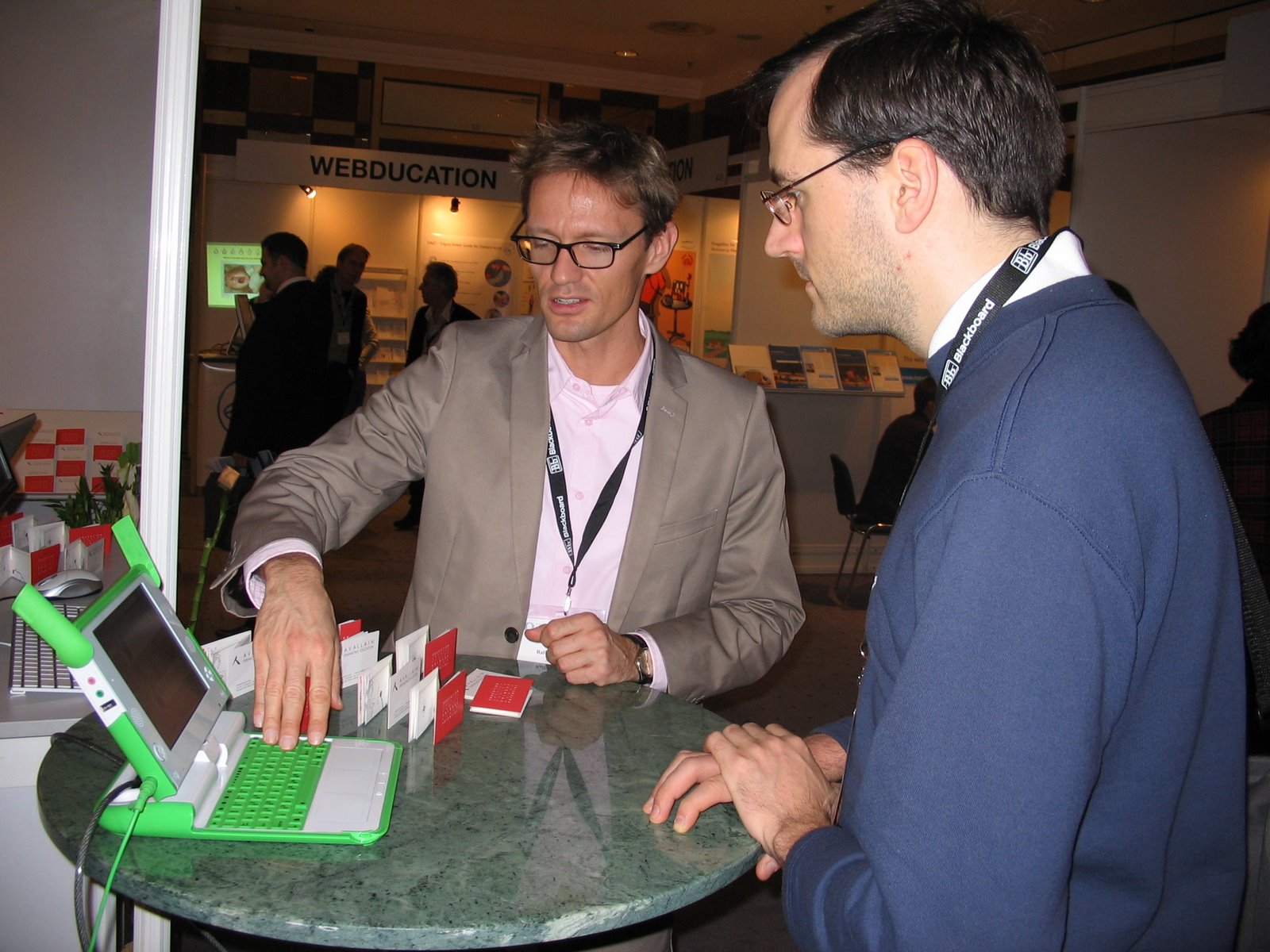 The production model of the OLPC laptop was there to see, touch and play with at one of the stands at Online Educa. Looks great and very small keyboard, optimised no doubt for kids' fingers. The buy one/give one scheme is still in operation in the US and Canada until the end of the month, but no sign yet of any over here in Europe except for occasional demos like this.
Berlin interview 3: Dietmar Kennepohl - Web-based Chemistry Labs
 Prof. Dietmar Kennepohl of Canada's Athabasca University (their Open University) presented examples of the web-based interface that they use to allow students to access chemistry instrumentation for sample analysis. Essentially, the student can take full control of the equipment from anywhere and at anytime that suits them. Of course the equipment is preloaded with a number of different sample materials from analysis, some of which will have been sent in to the lab by the students concerned. Such remote access to labs has been growing internationally in a range of technical subjects including Electrical Engineering (indeed our own Vice-President, Ger Hurley, published a paper on this topic last year) and Astronomy. MIT has also been pursuing the development of a comprehensive network of such equipment from many institutions across the globe as part of their iLab project. I spoke briefly with Dietmar about his work.
Berlin Interview 2: Sîan Bayne
 Sîan Bayne, who runs Edinburgh University's MSc in eLearning programme spoke at the final plenary session at Online Educa, where she wandered through the University's Second Life islands and spaces in a live demonstration and commented on its potential for overcoming the isolation experienced by students on distance learning programmes, providing as it does, a greater sense of 'presence' for online discussion. She did emphasise however the unheimlich nature of the SL experience: a slightly disturbing space of marionnettes, delay and the haunting background sound of the wind. I interviewed her briefly after the session.
Riots, storms and coincidences -another day in academe
Just returned from the Berlin conference and more reports and interview to follow, once I have recovered from the journey. What started out as a leisurely last day in the city ended up being a roller coaster drama. Emerging from the underground at Rudow, in order to take the express bus to the airport, I found myself surrounded by riot police and thousands of protestors beating drums, and blowing whistles with all the roads blocked off. It seemed like a counter demonstration to some other march and given that the people on the sidelines with the whistles and drums were waving red flags, green flags and various other hues, one senses that the marchers were of a somewhat less liberal inclination.
Anyway, after struggling through with case and rucsac, I had to jog the last 3.5km to the airport, desperate to check in on time. I was of course looking very suspicious and hassled by the time I arrived and all the wires and electrical equipment in my rucsac (minidisc recorder, microphone, etc) aroused suspicion and I was 'busted' by security. After that, 'plane' sailing until news of the storms battering Ireland filtered through and our aircraft made an almost sideways landing at Dublin. Then bumping into Alajandra, (me, not the plane) a post-doc in our team, at the airport where she had coincidentally just come in from a meeting in Geneva added to the surreality of the experience.
Anyway, recuperation, unpacking and then more stories from Online Educa to follow in the coming days.
Anyway, after struggling through with case and rucsac, I had to jog the last 3.5km to the airport, desperate to check in on time. I was of course looking very suspicious and hassled by the time I arrived and all the wires and electrical equipment in my rucsac (minidisc recorder, microphone, etc) aroused suspicion and I was 'busted' by security. After that, 'plane' sailing until news of the storms battering Ireland filtered through and our aircraft made an almost sideways landing at Dublin. Then bumping into Alajandra, (me, not the plane) a post-doc in our team, at the airport where she had coincidentally just come in from a meeting in Geneva added to the surreality of the experience.
Anyway, recuperation, unpacking and then more stories from Online Educa to follow in the coming days.
Subscribe to:
Comments (Atom)